
Value Betting : Guide des cotes
 Available in US
Look, if you’re going to throw money at Championship football matches, you’d better understand what those numbers actually mean. Not the surface-level stuff everyone thinks they know, but the real mechanics behind how odds work, why they move, and where the value hides in plain sight.
Most punters look at odds and see potential winnings. Smart bettors look at odds and see probability, market sentiment, and occasionally, glaring mistakes worth exploiting. The difference between these two approaches is literally the difference between slowly bleeding money and actually turning a profit over a season.
The Championship is perfect for learning this stuff because the league is chaotic enough that bookmakers struggle to price matches accurately, but structured enough that patterns exist if you know where to look. By the time you finish reading this, you’ll understand odds better than ninety percent of people placing bets this weekend. That’s not hyperbole. Most bettors never bother learning the fundamentals, which is precisely why bookmakers stay profitable.
We’re going to break down everything from the absolute basics to the advanced concepts that separate casual punters from serious bettors. No fluff, no unnecessary complexity, just the practical knowledge you need to read Championship odds like someone who actually knows what they’re doing.
Learn the technical side in our Championship value betting guide.
Table of Contents
The Fundamentals of Championship Betting Odds
Odds are simply the bookmaker’s way of expressing probability while building in their profit margin. Every set of odds you see represents two things simultaneously: an assessment of how likely something is to happen, and a markup that ensures the bookmaker makes money regardless of the outcome.

Let’s start with the three formats you’ll encounter. Fractional odds are traditional in the UK and look like this: 5/2, 11/4, 6/1. The first number shows your profit if you stake the second number. So 5/2 means if you bet two pounds, you profit five pounds, getting seven pounds total back. Decimal odds are cleaner and increasingly popular: 2.50, 3.75, 7.00. Your total return equals your stake multiplied by the decimal. Bet ten pounds at 2.50 and you get twenty-five pounds back, including your original tenner.
American odds use plus and minus signs: plus-250, minus-150. Positive numbers show profit on a hundred-unit stake. Negative numbers show how much you need to stake to profit a hundred units. They’re less common in UK betting but worth understanding if you’re comparing international markets.
Here’s what matters: all three formats express the exact same information, just in different languages. A fractional odd of 5/2 equals a decimal odd of 3.50 and an American odd of plus-250. They’re interchangeable, so use whichever format makes intuitive sense to you.
Now for the crucial bit that most punters never grasp. When you see Sheffield United listed at 1.90 to beat Hull City, the bookmaker isn’t just saying Sheffield is likely to win. They’re saying Sheffield has roughly a fifty-three percent chance of winning based on their assessment. But if you add up the implied probabilities of all three possible outcomes in that match, you get more than one hundred percent. That extra percentage is the overround, the bookmaker’s built-in profit margin.
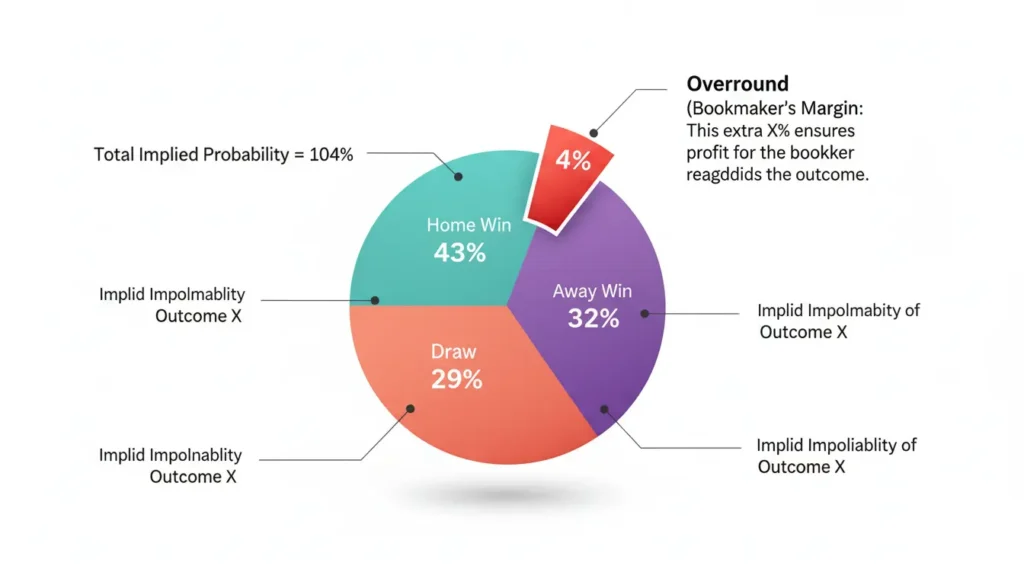
A typical Championship match might show home win at 2.30, draw at 3.40, away win at 3.10. Convert each to implied probability by dividing one by the decimal odds. That gives you roughly forty-three percent for the home win, twenty-nine percent for the draw, thirty-two percent for the away win. Add them together and you get one hundred four percent. That extra four percent is where the bookmaker makes their money. It’s their insurance policy against perfect information.
Understanding this changes everything about how you approach betting. Your job isn’t to pick winners. Your job is to find situations where you believe the true probability differs from the bookmaker’s assessment by more than their margin. If you think Sheffield United actually has a sixty percent chance of winning but the odds imply fifty-three percent, that gap represents potential value worth exploring.
The overround varies by market and bookmaker. Match result markets typically have tighter overrounds, around three to five percent, because they’re liquid and competitive. Obscure player prop markets might have overrounds of fifteen percent or higher because fewer people bet them and bookmakers need more protection. This is why finding value in mainstream markets is harder but not impossible, while niche markets offer bigger edges if you have specialist knowledge.
How Championship Odds Are Set

Bookmakers employ teams of traders whose job is pricing football matches. These aren’t random guesses. Trading teams use statistical models incorporating team form, head-to-head records, injuries, home advantage, motivation factors, and dozens of other variables. The models spit out initial probabilities which traders then adjust based on their own expertise and market expectations.
For big matches, multiple traders review the lines before they go live. For regular Championship fixtures, the process is faster but still rigorous. The opening odds you see reflect the bookmaker’s best assessment of probability plus their margin, released early enough to attract betting action but late enough that they have reasonable information about team selection and conditions.
Then reality hits and odds start moving. Several factors drive these movements, some informative and some just noise. Sharp money is the first and most important driver. Professional betting syndicates and individual sharps have better models, more data, and sometimes inside information that gives them edges. When sharp money hits a line hard, bookmakers respect it because sharps win long-term. If sharps are hammering Hull City at 3.10, the bookmaker moves Hull down to 2.90 or 2.80 to balance their book and reduce exposure.
Public money works differently. Recreational punters tend to overbet favorites, popular teams, and overs. This creates weight of money that bookmakers need to manage, but they don’t respect it the same way because public bettors lose long-term. Smart bookmakers sometimes let public money push lines in the wrong direction, essentially fading the public and accepting extra exposure because they know the public is wrong more often than right.
Team news moves lines dramatically. If Burnley’s starting striker picks up an injury in the warm-up, their odds drift immediately. If a key defender who was doubtful suddenly starts, odds tighten. Bookmakers have people monitoring team announcements, press conferences, and social media for any information that changes the probability assessment. The speed at which they react depends on how quickly they receive the information and how significant it is.
Weather matters more than casual observers realize, particularly for teams built around specific styles. Heavy rain or strong winds affect pitch conditions, favoring physical teams and hurting technical ones. Extreme heat in August drains fitness differently than cold November evenings. Bookmakers factor weather into their models, but if conditions change rapidly between when odds are set and kickoff, temporary inefficiencies appear.
Motivational factors are harder to quantify but hugely important in the Championship. A team fighting for automatic promotion in April treats every match differently than a mid-table team coasting to the season’s end. Bookmakers try to account for this through subjective adjustments to their model outputs, but motivation is slippery and creates opportunities for bettors who pay attention to the broader context.
Market sentiment and psychology play roles too. If everyone expects Norwich to smash Plymouth, the odds reflect that expectation even if the underlying probabilities don’t fully justify it. This is where contrarian thinking pays dividends. When the entire betting public leans one direction, the other side sometimes offers value simply because the odds have been pushed too far.
Championship odds are particularly interesting because the league’s unpredictability makes accurate pricing difficult. In the Premier League, everyone knows Manchester City should beat Luton most of the time. The quality gap is obvious and odds reflect it. In the Championship, the gap between first and fifteenth is much smaller. Bookmakers have less certainty, which means their models have wider error bands, which means opportunities exist for informed bettors.
Reading Championship Odds Across Different Markets
Every Championship match offers dozens of betting markets, each with its own odds and characteristics. Understanding how to read odds across these different markets is essential for finding value because sometimes the match result odds are efficient but the corners market is wildly mispriced, or vice versa.
Match result odds are your starting point. The 1X2 market showing home win, draw, away win is the most liquid and competitive. It receives the most attention from both bookmakers and bettors, which means the odds are usually pretty efficient. Not perfect, but harder to beat than niche markets. When you see Coventry at 1.80 to beat QPR at home, draw at 3.60, QPR at 4.50, you’re looking at the market consensus about this match’s most likely outcomes.
Pay attention to how match result odds shift relative to each other. If the home win tightens from 1.80 to 1.70 while the away win drifts from 4.50 to 5.00, that tells you money is coming in on the home side. If all three odds tighten proportionally, that suggests the match is attracting heavy betting action across all outcomes and the bookmaker is reducing their risk by tightening margins. These movements contain information about what other bettors think and what the bookmaker fears.
Over-under odds tell you about expected goal totals. The standard line sits at 2.5 goals, with odds for over and under usually hovering around 1.90 each, indicating the bookmaker sees both outcomes as roughly equal probability. But context matters enormously. If two attacking teams meet, the over might be 1.70 while the under is 2.20, reflecting the bookmaker’s belief that goals are more likely. If two defensive teams face off, those odds flip.
The key insight with over-unders is recognizing when the line is set incorrectly based on factors the bookmaker underweighted. Maybe two attacking teams are meeting but one is dealing with fixture congestion that will force them to play more conservatively. The over looks obvious but the under offers value because the bookmaker hasn’t fully adjusted for the congestion factor. These situational edges are where money gets made.
Both teams to score odds reflect the probability that each side finds the net at least once. In the Championship, BTTS lands roughly fifty-three percent of the time, so odds are often around 1.85 for yes and 1.95 for no. Teams with strong attacks but weak defenses are obvious BTTS candidates, but the odds reflect that. Better value comes from identifying matches where tactical matchups or motivational factors create goal-scoring opportunities that the odds underestimate.
Handicap odds adjust for perceived quality gaps by giving one team a virtual head start. Asian handicaps are most common, offering half-goal and quarter-goal lines that eliminate draws. If Leicester is minus-1.5 against Plymouth, they need to win by two clear goals. The odds on this might be 2.00, offering better value than backing Leicester straight up at 1.40 if you believe they’ll win comfortably. The flip side involves backing Plymouth at plus-1.5, which covers them losing by one goal, drawing, or winning outright.
Handicaps are particularly useful in Championship matches with clear quality gaps. Newly promoted teams hosting established playoff contenders often see handicaps of one or one-and-a-half goals. If your analysis suggests the favorite should dominate, the handicap offers better odds than the match result market. If you think the underdog will keep it close, taking them with the handicap cushion reduces your risk.
Outright market odds run throughout the season for championship winner, promoted teams, relegated teams, and top goalscorer. These markets offer some of the juiciest value in Championship betting because pricing forty-six matches accurately is extremely difficult. A team might start at 25-1 to win the league but drop to 8-1 after a strong opening month. That movement creates opportunities to back them early or lay them later, or to identify teams whose odds haven’t caught up with their performance.
The top goalscorer market requires analyzing both individual quality and team dynamics. A striker at a dominant team gets more chances than a better striker at a struggling side. Penalty takers have massive advantages since five or six converted penalties over a season can swing the entire market. Each-way terms often pay down to three or four places, which means you don’t need to pick the outright winner to profit.
In-play odds change constantly as matches unfold. A goal completely reshapes the probability landscape, causing dramatic odds movements that sometimes overcorrect and create value. If a stronger team goes behind early to a weaker opponent, their odds to win might balloon from 1.50 to 3.50 despite seventy-five minutes remaining to turn things around. If you believe they’ll equalize and win, that’s potentially massive value that only exists for a brief window.
Reading in-play odds requires understanding momentum and tactical adjustments. If a team trailing by one goal sends on three attacking substitutes with twenty minutes left, the over-under line will move and the next goal market shifts. If they bring on defensive reinforcements to protect a lead, the pace slows and the under becomes more attractive. These tactical signals aren’t always fully reflected in odds immediately, creating brief inefficiencies.
Comparing Championship Odds Like a Pro
Odds comparison is non-negotiable for serious betting. Different bookmakers offer different prices on the same outcomes, sometimes varying by ten or fifteen percent. Over hundreds of bets, consistently getting the best available odds is the difference between profit and loss. This isn’t optional. It’s fundamental.
The simplest comparison approach uses aggregator sites like Oddschecker or OddsPortal. These platforms display odds from dozens of bookmakers side by side, letting you identify the best price instantly. For a Championship match, you might see Norwich to beat Millwall offered at 1.75 by one bookmaker and 1.83 by another. That eight-point difference seems small but compounds significantly over a season. If you’re betting a hundred pounds, the difference is eight pounds per bet. Do that fifty times and you’ve gained or lost four hundred pounds simply based on which bookmaker you used.
But raw odds aren’t the only factor. Bookmaker reliability matters. A bookmaker offering slightly better odds but with a history of limiting winning players or slow withdrawals isn’t actually offering better value. You need the combination of competitive odds and reliable service. This is why experienced bettors maintain accounts at multiple established bookmakers rather than chasing the absolute best odds from sketchy operators.
Timing your bets optimally requires understanding when odds offer the most value. For most Championship matches, odds appear several days before kickoff and move as money comes in and information emerges. The conventional wisdom says bet early to get the best odds before they shorten. But that’s oversimplified and often wrong.
Early odds offer value when you have information or analysis the market hasn’t incorporated yet. If you’ve identified a motivational edge or tactical matchup that others haven’t noticed, betting early locks in odds before the market corrects. But early odds also carry more risk because team news hasn’t been confirmed. If your bet depends on a key player who then gets injured, you’re stuck with a bad position.
Late odds, placed close to kickoff, incorporate all available information including confirmed lineups. The odds are usually less generous because uncertainty has been resolved, but you’re betting with complete information. For bettors who don’t have informational edges, betting late after team news is confirmed often offers better expected value despite shorter odds because you’ve eliminated lineup risk.
The best approach depends on your edge. If your advantage is analytical, identifying patterns or matchups others miss, bet earlier to capture mispriced odds before the market corrects. If your advantage is informational, knowing about injuries or tactical changes before they’re public, bet as early as possible before that information spreads. If you don’t have a clear edge, betting late with full information reduces variance and prevents costly mistakes.
Line shopping means comparing odds across multiple bookmakers and always taking the best available price. This seems obvious but most recreational bettors use one or two bookmakers and never shop around. Professional bettors maintain accounts at six to ten bookmakers and place each bet wherever the odds are best. This discipline adds two to five percent to long-term returns, which is enormous when most bettors operate on thin margins.
Some bookmakers consistently offer better odds on specific markets. One might have the best match result odds, another excels at over-unders, a third offers superior outrights. Track which bookmakers offer best prices on the markets you bet most frequently and prioritize accounts there. This doesn’t mean ignoring others, but it streamlines your comparison process.
Betting exchanges offer a different dynamic entirely. Instead of betting against a bookmaker, you’re betting against other punters with the exchange taking a small commission on winning bets. The odds are often better than traditional bookmakers because there’s no built-in margin, just the commission. Lay betting, where you bet against an outcome rather than for it, opens up strategies impossible with traditional bookmakers.
The downside of exchanges is liquidity. For big Championship matches, exchanges have plenty of money available at good odds. For smaller matches or niche markets, liquidity dries up and odds worsen. Exchanges work best for experienced bettors comfortable with the mechanics of backing and laying and patient enough to wait for liquidity at their desired price.
Finding Value in Championship Betting Odds
Value is the holy grail of sports betting. It’s the only thing that matters in the long run. You can have a sixty percent win rate and still lose money if you’re consistently betting at poor odds. Conversely, you can win only forty-five percent of your bets and be profitable if you’re consistently finding value.
Value exists when your assessment of probability differs from the bookmaker’s implied probability by more than their margin. This sounds simple but executing it requires three things: accurate probability assessment, proper understanding of the bookmaker’s edge, and the discipline to only bet when genuine value exists.
Let’s walk through a practical example. Sunderland hosts Preston. The bookmaker offers Sunderland at 2.10, draw at 3.30, Preston at 3.80. Converting to implied probabilities gives us Sunderland forty-eight percent, draw thirty percent, Preston twenty-six percent. The overround is four percent, meaning the bookmaker’s true assessment is probably closer to Sunderland forty-six percent, draw twenty-nine percent, Preston twenty-five percent after removing their margin.
Now you do your analysis. Sunderland has won four of their last five at home, averaging 2.1 goals scored and 0.8 conceded. Preston has lost three of their last four away matches, averaging 0.9 goals scored and 1.6 conceded. Sunderland is fighting for a playoff position while Preston sits comfortably mid-table. Weather conditions favor Sunderland’s style. Based on all this, you assess Sunderland’s true winning probability at fifty-eight percent.
That twelve-point gap between your assessment and the bookmaker’s assessment represents significant value. The odds of 2.10 imply Sunderland wins forty-six percent of the time after removing the bookmaker’s margin. If they actually win fifty-eight percent of the time, you have a massive edge. Over a large sample of similar bets, this edge translates directly to profit.
The critical question is whether your assessment is more accurate than the bookmaker’s. This is where most bettors fall apart. They think they’ve found value but they’re just overconfident in flawed analysis. Bookmakers employ professional traders with sophisticated models and decades of data. Beating them requires genuine informational or analytical edges.
Championship betting creates value opportunities through its inherent unpredictability and the difficulty of pricing matches accurately. The quality gaps are smaller than in the Premier League, making upsets more common. The fixture congestion punishes squad depth differently than top leagues. The motivational factors swing wildly based on league position and time of season. All these factors create complexity that bookmakers struggle to fully capture in their odds.
Home advantage in the Championship is more pronounced than in the Premier League and bookmakers sometimes underprice it, particularly for teams with strong home records and intimidating atmospheres. A team that wins sixty percent of home matches but is offered at odds implying fifty-two percent represents clear value if your analysis confirms the home record is sustainable rather than fortunate.
Newly promoted teams often arrive overpriced in the early season because public perception lags behind reality. These teams dominated League One but face a massive step up in quality. Bookmakers know this but can’t price them too long because recreational money piles in backing them. This creates value on their opponents, particularly in the opening two months before the market fully adjusts.
Late-season motivational edges are criminally underpriced in Championship betting. A team fighting relegation hosting a mid-table side with nothing to play for creates a massive psychological advantage that odds often underestimate. The home team is fighting for their professional lives while the visitors are mentally on vacation. That intensity gap matters and creates value on the underdogs.
Teams dealing with fixture congestion are frequently overpriced as favorites because bookmakers and the public focus on their quality while underweighting their fatigue. A playoff-chasing team playing their third match in seven days might look like an obvious favorite on paper but their performance will likely be compromised. If the odds don’t fully reflect that fatigue factor, the underdog offers value.
Finding value consistently requires specialization. You can’t be an expert on all twenty-four Championship teams. Pick three or four teams and learn everything about them. Understand their tactics, strengths, weaknesses, key players, home-away splits, motivational factors. When those teams play, you’ll spot value the bookmakers miss because you know them better than their models do. This specialist knowledge compounds over a season and transforms random punting into systematic profit-taking.
The other approach is market specialization. Instead of following specific teams, become expert in specific markets. Maybe you focus exclusively on both teams to score, building models and tracking patterns until you know that market better than anyone. Or you specialize in corners, understanding which teams and referees generate the most and least corner kicks. This focused expertise creates edges in markets where bookmakers spread their attention thin.
Value betting requires patience and discipline. Most Championship matches don’t offer value at the odds available. If you’re betting every weekend just because matches are happening, you’re gambling rather than betting. Value bettors wait for situations where their edge is clear and their assessment genuinely differs from the market consensus. This might mean betting once or twice per weekend rather than ten times. The frequency doesn’t matter. The edge does.
Championship Odds Movement Patterns
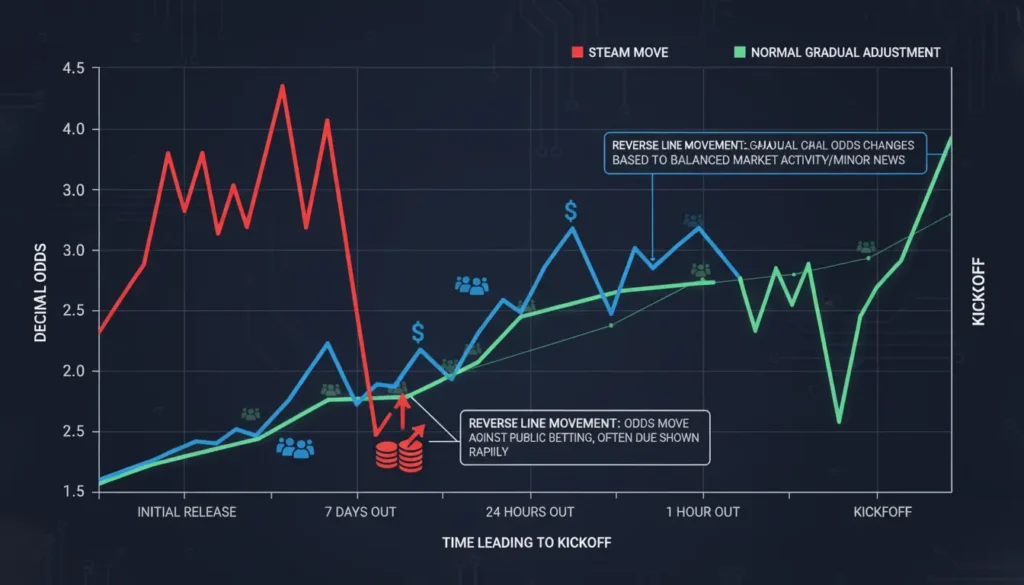
Watching how odds move reveals information about what’s happening behind the scenes. Professional bettors monitor line movements religiously because they contain signals about where smart money is flowing and what information might be emerging.
Steam moves happen when odds suddenly shift dramatically across multiple bookmakers simultaneously. This indicates sharp money hitting the market hard enough that bookmakers need to adjust quickly to manage their exposure. Steam moves are significant because they suggest someone with resources and information believes the current odds are wrong. Following steam moves blindly isn’t a strategy, but paying attention to them provides context about market sentiment.
Reverse line movement is even more telling. This happens when odds move opposite to where public money is flowing. If seventy percent of bets are on Sheffield United but their odds lengthen rather than shorten, that suggests sharp money is hammering the other side hard enough to overwhelm the public. Bookmakers trust sharp money over public money, so they move the line in the sharp direction despite being unbalanced. Reverse line movement is a powerful signal that informed money disagrees with the public.
You can track these movements through odds comparison sites that show historical odds movements, or by checking odds at different times leading up to matches. If Leicester opens at 1.60 on Monday and drifts to 1.75 by Friday despite no significant team news, something is happening. Maybe sharps identified value on the other side. Maybe there’s injury news not yet public. Maybe the bookmaker is worried about their exposure. Regardless, the movement contains information worth considering.
Odds movements after team news breaks are predictable and sometimes exploitable. If a key player’s absence is announced, odds shift immediately. But occasionally the market overreacts, particularly if the player’s importance is overstated or if the replacement is underrated. Smart bettors who understand team depth can exploit these overreactions by betting opposite to where the public is panicking.
Championship odds tend to move more than Premier League odds because the matches are less liquid and the uncertainty is higher. A moderate amount of sharp money can shift Championship lines significantly, whereas the same money would barely budge Premier League odds. This volatility creates opportunities but also risks. Getting caught on the wrong side of a steam move costs more in the Championship than in more liquid markets.
The pattern you’re looking for is value that exists at current odds but will disappear as the market corrects. If you identify value early and the odds subsequently shorten, you locked in better odds than latecomers. This is the entire game in a nutshell: identifying value before the market does and getting your money down before the odds adjust. Everything else is details.
Find overvalued prices on our EFL football hub.