
 Available in US
The English Football League Championship doesn’t mess around. Forty-six games of chaos, drama, and the kind of unpredictability that makes bookmakers nervous and bettors salivate. We’re talking about a league where bottom-placed teams regularly beat promotion favorites, where £200 million hangs in the balance, and where the phrase “form goes out the window” actually means something.
If you’ve ever watched a Championship match and thought “there’s no way that just happened,” you’re in the right place. This isn’t the Premier League with its predictable giants. This is football’s great equalizer, and understanding how to bet on it requires throwing out half of what you think you know about football betting.
Over the next few thousand words, we’re going to dig into everything that makes championship betting simultaneously frustrating and potentially profitable. You’ll learn why the Championship’s unique structure creates betting opportunities that simply don’t exist in other leagues, how to read odds like someone who actually knows what they’re doing, which markets offer the best value, and most importantly, how to avoid the mistakes that turn casual punters into walking cautionary tales.
Whether you’re completely new to sports betting or you’ve been losing money on accumulators for years, this guide will give you the framework to approach championship betting with something resembling a plan. Let’s get into it.
Table of Contents
Understanding Championship Betting: The Basics
What is the EFL Championship?
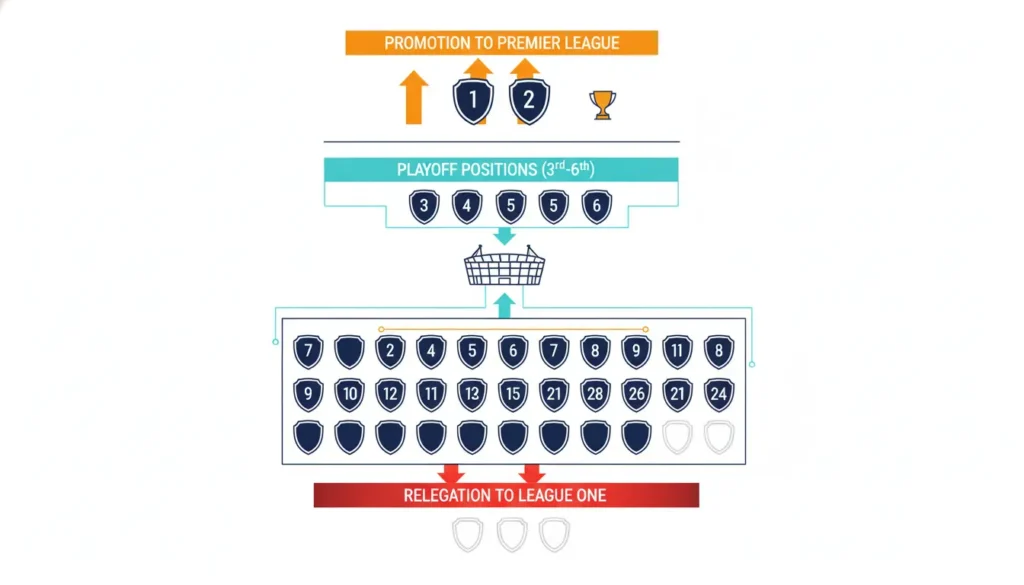
The Championship sits directly below the Premier League in English football’s pyramid, but calling it “second tier” undersells what makes it special. Twenty-four teams battle through a marathon season from August to May, each playing forty-six matches. That’s nearly twice as many games as most European leagues, and the physical and mental toll shows up in ways that create betting angles we’ll explore later.
At the end of this grueling season, the top two teams earn automatic promotion to the Premier League. The real theater happens with teams finishing third through sixth, who enter the playoffs. Two-legged semifinals followed by a single winner-takes-all final at Wembley. That final is often called the richest game in football, and for good reason. The financial difference between Championship and Premier League football approaches £200 million when you factor in television money, commercial revenue, and transfer budgets.
On the other end, the bottom three teams drop into League One, trading dreams of Premier League riches for fights to stay professional. This creates an environment where motivation varies wildly depending on where you sit in the table, and motivation is the kind of thing that matters when you’re trying to predict football matches.
Why Championship Betting is Different
Here’s something you need to understand right now: the Championship operates on different rules than top-flight football. Squad depth becomes a legitimate weapon rather than a luxury. A team like Leicester or Leeds might have Premier League-quality starting elevens, but ask them to play three matches in seven days and suddenly their lack of depth shows. Meanwhile, a mid-table team with a deeper squad can exploit fixture congestion.
The statistics back this up. Last season, home underdogs won outright in roughly eighteen percent of Championship matches, compared to about twelve percent in the Premier League. That six-point difference might not sound massive, but when you’re looking for value bets, it’s the difference between profit and loss over a season.
Then there’s the psychological element. A newly relegated Premier League team arrives with better players, bigger wages, and expectations of immediate promotion. But those same players might struggle with the physical demands of Championship football, the Tuesday-Saturday schedule, and the reality that every team treats matches against them like cup finals. These psychological factors create mispricing in betting markets, especially early in the season.
The Championship also rewards knowledge over lazy assumptions. In the Premier League, everyone knows Manchester City will probably beat Burnley. The odds reflect that. In the Championship, the gap between first and fifteenth is dramatically smaller, which means bookmakers have a harder time pricing matches accurately. That difficulty becomes your opportunity.
Championship Betting Terminology You Need to Know
Before we go further, let’s make sure we’re speaking the same language. Odds come in three main formats. Fractional odds are traditional in the UK and look like this: 5/2, 11/4, or 6/1. The first number shows your profit relative to the second number as your stake. Decimal odds are popular in Europe and simpler to understand: 2.50, 3.75, 7.00. Your total return including stake equals your wager multiplied by the decimal. American odds use plus and minus numbers: +250, -150. Positive numbers show profit on a hundred-unit stake, negative numbers show how much you need to stake to profit a hundred units.
Your stake is simply how much money you’re risking on a bet. Returns are what comes back if you win, including your original stake. A void bet happens when something makes the wager invalid, usually due to match postponement or specific bet conditions not being met. Your stake gets refunded. Settlement is when the bookmaker officially grades your bet as won or lost and credits your account accordingly.
In Championship-specific terms, you’ll encounter playoff odds (betting on which team wins the playoff final), promotion markets (betting on which teams finish top six or top two), and outright winner bets (picking the team that finishes first after forty-six matches). Understanding these terms matters because misunderstanding them is an expensive mistake.
Championship Betting Odds Explained

How Championship Odds Work
Every set of odds represents two things simultaneously: the bookmaker’s assessment of probability and their built-in profit margin. When you see Leeds United listed at 2.00 to beat Millwall, the bookmaker is saying Leeds has roughly a fifty percent chance of winning. But here’s the catch: if you add up the implied probabilities of all possible outcomes in a match, they total more than one hundred percent. That extra percentage is the bookmaker’s edge, their insurance policy against going bankrupt.
For a typical Championship match, you might see home win at 2.30, draw at 3.40, and away win at 3.10. Converting these to implied probabilities gives you roughly forty-three percent for the home win, twenty-nine percent for the draw, and thirty-two percent for the away win. Add those together and you get one hundred four percent. That extra four percent is the overround, the bookmaker’s theoretical profit margin on that market.
Understanding this matters because your job as a bettor isn’t to pick winners. Your job is to find situations where the bookmaker’s assessment is wrong enough that even after accounting for their margin, you’re getting value. If you genuinely believe Leeds has a sixty percent chance of winning but the odds imply fifty percent, that’s a value bet worth considering.
Odds move for several reasons, and watching these movements can tell you things about a match. Sharp money from professional betting syndicates can move lines dramatically. These bettors have resources and information that recreational punters don’t, and bookmakers respect their action. When sharp money comes in heavily on one side, odds adjust to balance the book. Public money, or what people in the industry call “square money,” tends to follow favorites and over-bets popular teams. This can actually create value on the other side.
Team news is the most obvious odds mover. If Burnley’s starting striker picks up an injury in training two hours before kickoff, their odds to win will drift outward immediately. Weather can matter too, particularly for teams that rely on playing football on the ground versus teams built for aerial battles. Even something as simple as a managerial statement in a press conference can shift odds if it suggests team selection or tactical changes.
Reading and Comparing Championship Odds
Match odds appear first and represent the 1X2 market: home win, draw, away win. These are your bread and butter, the market with the most liquidity and generally the tightest margins. But Championship betting offers dozens of other markets per match. Over-under goals, both teams to score, correct score, Asian handicaps, first goalscorer, and countless player props all have their own odds.
Outright markets run throughout the season and include championship winner, promoted teams, relegated teams, and top goalscorer. These markets offer some of the best value opportunities in Championship betting because they’re difficult to price accurately over such a long season. A team might start at 25/1 to win the league but drop to 10/1 after a strong opening month, creating opportunities to either back them or trade out for profit.
Pro Tip: The best odds guarantee is something many UK bookmakers offer. If you take a price on a horse race and the starting price ends up higher, they’ll pay you at the bigger odds. Some bookmakers extend this concept to football, particularly for outright markets. It’s not standard, but when available, it’s essentially free insurance against taking odds that later improve.
Using odds comparison sites effectively means understanding what you’re looking at. The highest odds aren’t always the best value if they’re from a bookmaker known for limiting winning players or if withdrawal terms are problematic. The goal is finding the best combination of competitive odds, reliable service, and betting limits that accommodate your stakes. Sites like Oddschecker and OddsPortal aggregate prices across dozens of bookmakers, saving you the tedious work of checking manually.
Value Betting in Championship Markets
Value is the single most important concept in successful sports betting, and yet most bettors never truly grasp it. A value bet isn’t about backing underdogs or finding long odds. It’s about identifying situations where your assessment of probability differs from the bookmaker’s assessment by enough to overcome their margin.
Let’s work through an example. Norwich City hosts Sheffield Wednesday. The bookmaker offers Norwich at 1.90, which implies about a fifty-three percent chance of a home win. You’ve done your research: Norwich has won four of their last five at Carrow Road, Wednesday has lost three straight away matches, and Norwich has no significant injuries while Wednesday is missing their starting center-back. Based on this information, you assess Norwich’s actual probability of winning at sixty-five percent.
That eleven-point difference between your assessment and the bookmaker’s implied probability represents significant value, assuming your analysis is correct. Over a large sample size, consistently finding this kind of edge is what separates profitable bettors from recreational punters.
The Championship creates value opportunities through its sheer unpredictability. Bookmakers struggle to price matches accurately when the quality gap between teams is relatively small and motivation varies wildly. A mid-table team with nothing to play for in April might be overpriced as favorites against a team fighting relegation. A promotion-chasing team facing fixture congestion might be underpriced against a well-rested opponent.
Home advantage in the Championship is real and meaningful. Home teams win roughly forty-six percent of matches, draw twenty-seven percent, and lose twenty-seven percent. This is more pronounced than in the Premier League, where home advantage has been declining. Yet bookmakers sometimes underprice home underdogs, particularly when a “bigger” team visits. This is where doing your homework on specific stadiums, crowd atmospheres, and individual team home records can pay dividends.
Essential Championship Betting Markets

Match Result Betting
The traditional 1X2 market remains the foundation of football betting for good reasons. It’s straightforward, the margins are relatively tight, and there’s enormous liquidity meaning large stakes won’t move the market. In the Championship, match result betting rewards knowledge of team tendencies and situational factors more than in leagues where quality gaps are obvious.
When using this market, pay attention to recent form but don’t be enslaved by it. A team that’s won five straight might be due for regression, especially if those wins came against weaker opposition or via fortunate circumstances. Similarly, a team on a losing streak might be performing better than results suggest, setting up a value opportunity when odds don’t reflect their underlying quality.
Championship home and away splits matter enormously. Some teams are completely different animals at home versus on the road. Middlesbrough might be defensively solid at the Riverside but vulnerable when traveling. Preston might grind out home wins but struggle to impose themselves away. These patterns persist across seasons and create betting opportunities when bookmakers don’t fully account for them.
Over-Under Goals Markets
The Championship averaged 2.45 goals per match last season, which falls right around the standard 2.5 goals line that bookmakers commonly use. This makes the over-under market fascinating because it’s genuinely balanced, neither side having an inherent edge. Your job becomes identifying matches where conditions suggest deviation from this average.
Interactive tool
Playoff Bracket Odds & Matched Betting
What finishing third is actually worth once the bracket is drawn — and what a “Bet £20, Get £20” offer really pays.
What third place is worth
–
Top seed
–
Bottom seed
–
If seeding were free
25.0%
Season points for each playoff side
Chance of going up through the playoffs
3rd beats 6th
–
4th beats 5th
–
Points spread, 3rd to 6th
–
Probabilities sum to
–
Why the model has no draws: nothing in the playoffs can finish level. Two legs then extra time and penalties resolve the semi-finals, and the same applies at Wembley, so every stage is a straight two-way outcome. The higher seed gets one structural gift only — hosting the second leg — and the final is played on neutral ground, which is why a whole season of separation buys far less than people assume.
Locked profit from the offer
–
–
Lay the qualifier
–
Lay the free bet
–
Free bet retention
–
Qualifying bet
Free bet (stake not returned)
The rule nobody writes down: a free bet returns no stake, so its value rises with the price you put it on. The same £20 token is worth about 46% of face value at even money and over 80% at 9.00. Move the free bet odds in the box above and watch the retention figure climb — that single number is the whole discipline.
High-scoring teams face each other: that’s an obvious over candidate, right? Sometimes. But if both teams have excellent defensive records, they might cancel each other out. The better approach is looking for mismatches in playing styles. An attack-minded home team against defensively weak visitors often produces goals. A defensively organized team hosting opponents who must attack to meet their own objectives can also create goal-scoring opportunities.
Weather matters more than casual bettors realize. Heavy rain or strong winds favor over bets because goalkeepers struggle with long-range shots and crosses become unpredictable. Conversely, perfect conditions often lead to more controlled, lower-scoring matches because both teams can execute their game plans effectively.
The time of season influences goal totals too. Early-season matches tend to feature more goals as fitness levels vary and teams are still solidifying defensive organization. Late-season matches involving teams with nothing to play for can go either way: sometimes they’re high-scoring because neither team commits defensively, sometimes they’re boring stalemates because intensity is lacking.
Both Teams to Score
BTTS is arguably the most popular market after match result, and for good reason: you only need each team to score once, and recent Championship seasons have seen both teams score in about fifty-three percent of matches. That frequency makes it an attractive market for accumulator builders, though as we’ll discuss later, blindly throwing BTTS selections into accas is a recipe for long-term losses.
The key to successful BTTS betting is identifying matches where both teams are likely to create chances rather than simply backing it whenever two decent attacking teams meet. A team might score freely at home but struggle on the road. A defensively weak team might tighten up against superior opposition. Context matters more than raw statistics.
Teams with strong attacks but weak defenses are obvious BTTS candidates, but the odds on these matches often accurately reflect that. Better value comes from situations where both teams need goals for different reasons. A promotion-chasing home team against an opponent fighting relegation creates urgency at both ends. Mid-table teams might adopt more open, attacking approaches against each other than they would against top sides, creating unexpected BTTS value.
One underrated BTTS angle: teams that concede early often push forward desperately to equalize, creating counter-attacking opportunities for their opponents. This is more pronounced in the Championship than in the Premier League because the quality gap between teams means defenses are more vulnerable to sustained pressure.
Handicap Betting
Asian handicaps remove the draw possibility by giving one team a virtual head start or deficit. If you bet Sheffield United minus-one against Rotherham, Sheffield must win by two clear goals for your bet to win. If they win by exactly one goal, the bet is void and your stake is refunded. This is the half-goal version. Full-goal handicaps work similarly but can result in pushes rather than voids.
Handicaps are useful when you believe a team will win but the match result odds don’t offer value. Instead of backing the favorite at 1.50, you might get 2.00 on them with a minus-one handicap. You’re taking additional risk by requiring them to win by two, but if your analysis suggests they’ll win comfortably, the improved odds make it worthwhile.
In the Championship, handicaps work particularly well in matches featuring newly promoted League One teams hosting established Championship sides in the opening months of the season, or when promotion favorites face teams already resigned to relegation late in the campaign. These situations create the kind of quality gaps that make handicaps valuable.
The flip side involves backing underdogs with plus-one or plus-one-and-a-half handicaps. If you believe an underdog might keep a match close even if they don’t win outright, the handicap offers better value than backing them straight up. A team might be 5.00 to win but only 2.20 with a plus-one handicap. If you think they’ll either win or lose by a single goal, that’s attractive.
Championship Outright Betting
Betting on the outright winner, promoted teams, or relegated teams before or during the season offers some of the best value in Championship betting. These markets are notoriously difficult to price accurately because forty-six matches is a massive sample size where variance plays a huge role. Injuries, managerial changes, transfer windows, and momentum shifts can dramatically alter a team’s trajectory.
The key to outright betting is timing. Pre-season odds often overprice the previous season’s playoff teams and underprice newly relegated Premier League sides who haven’t yet added Championship-quality depth to their squads. After ten matches, patterns begin emerging and odds adjust, creating opportunities to back teams who’ve started strongly but aren’t yet fully reflected in the prices, or to oppose teams whose odds haven’t caught up with their poor form.
Promotion markets typically offer better value than winner markets because three teams achieve promotion. You can spread your risk across multiple selections and still profit if two or three come through. Some bookmakers offer each-way terms on promotion, paying out at reduced odds if your team finishes in the top six even if they don’t get promoted, adding another layer of security.
Top goalscorer betting requires analyzing not just individual quality but team style and penalty responsibilities. A striker at a dominant team will get more chances than a better striker at a struggling side. Penalty takers have an enormous advantage; five or six converted penalties over a season can mean the difference between winning and finishing second in the goalscoring charts.
In-Play and Live Betting
Live betting transforms the Championship experience, letting you react to what’s actually happening rather than predicting what might happen. The Championship’s chaotic nature makes it particularly well-suited to in-play betting because momentum swings are frequent and often predictable if you’re paying attention.
The most valuable live betting strategy is waiting for the first goal. Odds shift dramatically after goals, often overcorrecting and creating value. If a stronger team goes behind early to a weaker opponent, their odds to win might balloon despite them still being the better team with seventy-five minutes to turn things around. Conversely, if that stronger team scores first, odds on the underdog might offer value if you believe they’ll push forward desperately and create chances.
Substitutions provide information that odds might not immediately reflect. If a manager sends on three attacking players with twenty minutes remaining, that’s a clear signal of intent that might not be fully priced into the over-under or next goal markets. If a team protecting a one-goal lead brings on defensive reinforcements, the pace of the match will likely slow, affecting in-play totals.
Red cards are obvious inflection points, but the direction they move odds depends on context. A red card for the trailing team is devastating to their chances. A red card for the leading team might actually help them defend their advantage by forcing them into a more compact shape and running down the clock. These nuances create value for bettors who understand the tactical implications rather than blindly backing whichever side has eleven players.
Proven Championship Betting Strategies

Form-Based Betting Strategy
Form is useful but overrated. Everyone has access to the same win-loss records, so strong recent form is usually already baked into the odds. The trick is understanding what’s behind the form and whether it’s sustainable. A team might have won four straight matches, but if three came against bottom-six opposition and they needed late penalties to win two of them, that’s less impressive than the record suggests.
Dig deeper than surface results. Expected goals data shows whether a team is creating quality chances or getting fortunate with finishing. If a team is significantly outperforming their expected goals, regression is likely coming. If they’re underperforming their expected goals while still picking up points, they might actually be better than their league position suggests.
Home and away form splits reveal more than overall form. Some teams are completely different propositions depending on location. Blackburn might be genuine promotion contenders at Ewood Park but mid-table standard on the road. When these teams meet opponents with the opposite profile, the match becomes more predictable than odds might suggest.
Form cycles exist in the Championship’s condensed schedule. Teams that play Tuesday-Saturday-Tuesday-Saturday for weeks on end eventually hit physical walls. Monitor fixture lists and watch for teams entering heavy periods after international breaks or cup runs. Fatigue manifests in late goals conceded and dropped points against theoretically weaker opposition.
Statistical Analysis Approach
Statistics are powerful tools when used correctly and dangerous weapons when misapplied. The key is knowing which statistics actually predict future performance rather than simply describing past performance. Goals scored and conceded matter less than the underlying numbers that lead to goals.
Expected Goals (xG) measures the quality of chances a team creates and concedes. A team consistently creating better chances than their opponents will likely rise up the table even if results haven’t reflected it yet. This creates betting value when odds lag behind underlying performance. Similarly, a team overperforming their xG might be ripe to oppose because luck eventually regresses to the mean.
Shots on target percentage reveals efficiency. Two teams might average fifteen shots per match, but if one gets seven on target while the other gets four, the first team is creating better opportunities. Combined with save percentage data for goalkeepers, you can identify teams likely to start or stop finding the net.
Possession statistics are basically meaningless without context. Some teams dominate possession by design, others absorb pressure and counter-attack. What matters is whether a team’s possession leads to chances. If a team has sixty percent possession but creates fewer xG than their opponents, they’re not actually dominating the match despite what the stats suggest.
Fixture Congestion Strategy
The Championship’s brutal schedule creates one of its most exploitable betting angles. When teams play three matches in eight days, squad depth becomes the primary determinant of performance. This is where smaller clubs with tight-knit squads actually have advantages over bigger clubs who can’t rotate because their backup players represent significant quality drops.
Identify upcoming fixture piles before bookmakers fully account for them. If a top team has a midweek away cup match followed by a Saturday Championship away fixture, the Saturday match might offer value on their opponents even if the top team is objectively better. The physical and mental toll of two away matches in four days is enormous, and Championship pitches in February aren’t conducive to pretty football.
Cup competitions matter differently depending on a team’s league position. A mid-table team might treat FA Cup matches as opportunities to rest key players. A struggling team might see cups as distractions from their relegation fight. A promotion-chasing team might rotate heavily in cup matches to stay fresh for league fixtures. These decisions create preview information for their next league match.
Post-international break matches are fascinating because some players return exhausted from long flights and competitive matches while others stayed home and trained normally. Teams heavily reliant on international players often underperform immediately after breaks, while teams built around domestic players might actually benefit from the rest period.
Promotion and Relegation Battle Angles
Motivation is everything in football, and motivation varies wildly depending on table position and time of season. A team chasing automatic promotion in March will treat every match like a cup final. A team safely mid-table might be coasting toward summer vacation. This creates massive value opportunities when odds don’t fully account for motivational differences.
Late-season relegation battles are particularly exploitable. Teams fighting to stay up play with desperation and intensity that can overcome quality gaps. A bottom-three team hosting a mid-table side in April might actually be worth backing despite inferior overall quality. The visitors have nothing to play for while the hosts are fighting for their professional lives. That psychological edge matters enormously.
Conversely, teams that have achieved their primary objective, whether that’s securing promotion or avoiding relegation, often experience significant performance drops in their final matches. Once the pressure is off, intensity decreases. This is most pronounced in the Championship because unlike the Premier League where prize money varies significantly by final position, there’s little incentive to fight hard once your fate is sealed.
The playoff positions create unique situations. Teams fighting for sixth place know they’ll get a promotion opportunity regardless of whether they finish third or sixth, which can lead to inconsistent performances once they’ve secured a playoff spot. Meanwhile, teams just outside the playoffs might play with increased urgency and desperation, creating value when they face teams who’ve already clinched positions.
The Accumulator Strategy
Accumulators are simultaneously the most popular and most unprofitable betting strategy for recreational punters. The allure is obvious: turn a small stake into a large payout by combining multiple selections. The problem is that bookmakers love accumulators because they’re extremely difficult to win and their margins compound with each additional leg.
Smart Acca Building: If you’re going to bet accumulators, and knowing the math is against you but you enjoy the entertainment value, follow some basic principles. Keep them small. Three or four selections maximum. The difference between a four-fold accumulator and an eight-fold accumulator isn’t just that the eight-fold pays more; it’s exponentially harder to win. Every additional leg multiplies the probability of failure.
Mix different types of selections rather than backing four favorites to win. Combine match results with over-unders or both teams to score selections. This diversification doesn’t improve your mathematical expectancy, but it reduces the correlation between your selections. If you back four favorites from the same matchweek and it’s a weekend of upsets, all four lose together.
Use banker bets strategically. A banker is the selection you’re most confident in, the one that feels closest to certainty. Build your accumulator around this banker and keep other selections modest in odds. A proper banker might be 1.50 or 1.60, not 1.10. The latter offers too little value to be worth including.
Acca insurance is a promotion some bookmakers offer where they refund your stake as a free bet if one selection in your accumulator loses. This slightly improves your expected value but shouldn’t fundamentally change your approach. The best accumulator strategy is usually not betting them at all, but if you do, treat them as entertainment rather than investment.
Hedging and Bankroll Management
Proper bankroll management is the difference between recreational gambling and serious betting. Decide how much money you can afford to lose, and I mean genuinely lose without impacting your life. That’s your bankroll. Never bet more than one to three percent of your bankroll on a single match. This percentage ensures that even a terrible losing streak won’t destroy your ability to continue betting.
The unit system provides structure. One unit equals one percent of your bankroll. If your bankroll is one thousand pounds, one unit is ten pounds. Rate your confidence in each bet and stake accordingly. Your strongest plays might be three units, standard plays two units, speculative value plays one unit. This system automatically adjusts your stake sizes as your bankroll grows or shrinks.
Tracking every bet you place is non-negotiable. Use a spreadsheet with columns for date, match, bet type, odds, stake, result, and profit or loss. After a few months, patterns emerge. You might discover you’re profitable on home underdogs but lose money on favorites. You might realize your BTTS bets do well but your over-unders don’t. This data is invaluable for refining your approach.
Hedging means placing a bet opposite to your original position to guarantee profit or minimize losses. This is most common with outright bets that are winning but not yet settled. If you backed a team to win the Championship at 20/1 before the season and they reach the final day in first place, you might hedge by backing their closest competitor to reduce your risk. You’ll profit regardless of who wins, just less than if you’d let the original bet ride.
Advanced Championship Betting Techniques

Exploiting Market Inefficiencies
Market inefficiencies exist wherever bookmakers struggle to price something accurately. In the Championship, this happens most often with newly promoted teams, newly relegated teams, and teams undergoing significant changes. Public perception moves slowly while reality shifts quickly, creating temporary mispricings.
Newly promoted League One teams typically start the season overpriced to win matches. The Championship is a massive step up in quality, and teams that dominated League One often struggle immediately. Bookmakers know this but can’t price these teams too long because enough public money comes in backing them. This creates value on their opponents, particularly in the opening months.
The manager bounce effect is real and quantifiable. Teams that sack their manager and appoint a replacement typically see improved performances in the first five to ten matches under the new boss. This isn’t magic; it’s regression to the mean combined with increased effort from players trying to impress. Bookmakers adjust odds for new managers, but not always fully, especially if the new manager isn’t a big name.
Transfer window impacts often aren’t fully reflected in odds until several matches after the window closes. A team that significantly strengthens its squad in January might need three or four matches to integrate new players before performances improve. During this integration period, odds might not fully reflect their improved quality, creating value.
Matched Betting and Arbitrage
Matched betting exploits bookmaker free bet promotions to guarantee profit by backing and laying the same outcome. This isn’t a betting strategy in the traditional sense because you’re not trying to predict outcomes. You’re using mathematical certainty to extract value from promotional offers. It’s time-consuming and requires accounts at multiple bookmakers and betting exchanges, but it’s low-risk.
How Matched Betting Works
The process works like this: a bookmaker offers a “Bet £20, Get £20 Free Bet” promotion. You place a £20 qualifying bet on an outcome and simultaneously lay that same outcome on a betting exchange. You’ll lose a small amount on the qualifying bet due to the exchange commission, but you’re now eligible for the £20 free bet. You then use the free bet on another outcome while laying it on the exchange. The free bet converts to real money, and your exchange lay wins cover any losing free bet.
Arbitrage betting involves finding odds discrepancies between bookmakers that allow you to back all possible outcomes of an event and guarantee profit regardless of result. This happens when different bookmakers significantly disagree on probabilities. It’s rare in liquid markets like Championship match results but occasionally appears in niche markets or when one bookmaker is slow to adjust odds after team news.
Both matched betting and arbitrage carry risks. Bookmakers dislike both practices and may limit or close your accounts if they detect patterns. Mistakes in calculations can turn guaranteed profits into losses. And the profit margins are often small, requiring significant time investment relative to returns. These are tools in the arsenal but not sustainable long-term strategies for most bettors.
Specialist Markets
Beyond traditional markets lie dozens of specialist options. Corners betting rewards knowledge of team tactics. Teams that cross frequently generate more corners. Teams defending deep concede corners. Historical corner data is publicly available and bookmakers sometimes misprice these markets because they receive less attention than mainstream options.
Cards betting follows similar logic. Aggressive teams collect more yellow cards. Referees vary in strictness; some average four cards per match, others average six. Matches between rivals or with playoff implications see more cards due to increased intensity. These patterns persist and create value for bettors willing to track them.
Player props include anytime goalscorer, first goalscorer, player to be carded, and shots on target. These require deep knowledge of individual players. Which striker is on penalties? Which defender picks up cards frequently? Which midfielder shoots from distance? This specialist knowledge gives you edges bookmakers can’t fully account for because they’re pricing hundreds of players across dozens of matches.
Bet builders let you combine multiple selections from the same match into one bet with combined odds. These are fun but typically offer worse value than placing the same selections separately because bookmakers adjust odds to account for correlation. If you bet a team to win and over 2.5 goals, those outcomes are correlated (the team winning makes goals more likely), so the combined odds will be less favorable than if the outcomes were independent.
Common Championship Betting Mistakes to Avoid
Even experienced bettors fall into traps that destroy bankrolls. Learn from others’ mistakes:
- Betting with emotion – Supporting a team makes you biased toward their chances, causing you to overestimate their probability of winning and underestimate their opponents. The solution is simple: never bet on your own team, or if you must, only back them when they’re underdogs and you can objectively justify the value.
- Ignoring fixture congestion – It costs money because it’s predictable and bookmakers often underprice its impact. Teams playing their third match in seven days are measurably worse than they are when well-rested, yet odds sometimes don’t fully reflect this. Make fixture analysis part of your routine before every bet.
- Overloading accumulators – With six, eight, or ten selections turns betting into lottery tickets. The odds look attractive but the probability of winning is vanishingly small. If you enjoy accumulators, keep them small and focused. Three carefully selected legs offers much better value than eight random ones.
- Not tracking bets – This is self-sabotage. You cannot improve without data. You cannot identify your strengths and weaknesses without records. The ten minutes it takes to update a spreadsheet after each bet will save you hundreds or thousands of pounds in prevented mistakes.
- Betting without research – If you’re placing wagers based on team names or gut feelings rather than analysis, you’re donating money to bookmakers. Every bet should have reasoning behind it, even if that reasoning ultimately proves wrong. The process matters as much as the outcome.
- Chasing losses – This is how recreational punters become problem gamblers. You have a bad weekend and feel compelled to win it back immediately with bigger stakes or riskier bets. This spiral destroys bankrolls faster than anything else. Accept losses as part of betting. No one wins every bet. Even successful professional bettors lose forty to forty-five percent of the time.
Championship Betting FAQ
What makes Championship betting different from Premier League betting?
The Championship’s unique structure creates betting opportunities that don’t exist in the Premier League. The quality gap between the best and worst teams is dramatically smaller, making upsets more common and bookmakers less certain about outcomes. The forty-six match schedule creates fixture congestion that punishes teams with weak squad depth, creating exploitable patterns. Motivation varies wildly depending on table position and time of season, from promotion desperation to mid-table apathy. The Premier League’s predictability makes it harder to find value; the Championship’s chaos creates it.
How do Championship playoff bets work?
Playoff betting involves teams finishing third through sixth. These four teams enter two-legged semifinals: third plays sixth, fourth plays fifth. Winners advance to the final at Wembley, a single winner-takes-all match for the final promotion spot. You can bet on playoff winner outright, individual semifinal matches, or the final itself. Historical data shows teams finishing third or fourth win the playoffs slightly more often than fifth or sixth, but the difference is smaller than you’d expect. Momentum and form going into playoffs matter more than regular season position. The playoff final is the richest single match in football, worth roughly two hundred million pounds to the winner.
What are the most profitable Championship betting markets?
No single market is universally most profitable, but certain patterns hold. Both teams to score offers value when odds suggest low probability but context suggests otherwise. Value underdogs in specific situations (home team fighting relegation against mid-table visitors) consistently beat their implied odds. Outright promotion markets offer value because they’re difficult to price accurately over forty-six matches. The key is finding markets where your edge exceeds the bookmaker’s margin. For most bettors, specializing in two or three markets and becoming genuinely expert in them beats spreading attention across dozens of options.
Conclusion: Mastering EFL Championship Betting
The Championship is gloriously unpredictable, and that unpredictability is exactly what makes it worth betting on. Every weekend delivers drama that would seem implausible if you wrote it as fiction. Last-placed teams beat promotion favorites. Playoff finals go to extra time. Teams surge from mid-table to second place in six weeks. This chaos frustrates casual bettors but rewards those who do the work.
Success in Championship betting comes from treating it as a skill to develop rather than luck to hope for. Research team news, understand tactical matchups, track your bets, manage your bankroll, and find edges the bookmakers miss. None of this guarantees winning every bet, but it transforms betting from random gambling into calculated risk-taking with positive expected value.
The most important advice: bet responsibly, never risk money you can’t afford to lose, and remember that even the best bettors lose four out of ten bets. If you’re not enjoying it or it’s causing financial or emotional stress, step away. Betting should enhance your enjoyment of football, not diminish it. Now get out there and find some value.