
Paris Combinés : Conseils et Méthodes
 Available in US
Accumulators are the guilty pleasure of football betting. Everyone knows they’re mathematically awful. The margins compound with each leg you add, turning what might be reasonable odds on individual bets into bookmaker gold mines. Yet we keep building them anyway because that distant possibility of turning a fiver into three hundred quid is intoxicating enough to override rational thought.
The Championship is particularly seductive for accumulator building. You’ve got matches all weekend, odds that feel more generous than Premier League prices, and enough unpredictability that backing a few favorites doesn’t seem completely suicidal. Throw in the fact that most bookmakers offer acca boosts and insurance, and suddenly that eight-fold accumulator with Leicester, Leeds, Burnley and five other teams feels almost sensible.
Here’s the uncomfortable truth though: most accumulator bettors lose money consistently over time. Not because they’re unlucky, but because they’re building accumulators wrong. They’re chasing big payouts rather than building sensible combinations. They’re throwing in random selections because the odds look good without actually analyzing whether those selections offer value. They’re treating accumulators like lottery tickets instead of calculated betting strategies.
But accumulators don’t have to be money pits. Built intelligently with proper selection criteria, reasonable size limits, and disciplined staking, they can be part of a sustainable betting approach. Not the entire approach, mind you, but a legitimate component of it. This guide will show you how to build Championship accumulators that aren’t just optimistic fantasies but actually have reasonable chances of landing while still offering attractive returns.
Find more advanced tips in our Championship accumulator betting guide.
Table of Contents
Championship Accumulator Betting Explained

The mechanics of accumulators are straightforward enough. You combine multiple selections into one bet where all selections must win for the bet to pay out. The odds multiply together, creating potentially large returns from small stakes. A four-fold accumulator with each selection at 2.00 pays out at 16.00. The same four selections as single bets would require sixteen times the stake to generate the same total return.
This multiplication is simultaneously the appeal and the trap. Yes, you’re getting leverage on your stake. But you’re also multiplying risk. If three selections win and one loses, you get nothing. Zero. Your entire stake evaporates. This all-or-nothing dynamic is what makes accumulators thrilling and dangerous in equal measure.
The types of accumulators vary by size. A double combines two selections. A treble combines three. Four-folds, five-folds, six-folds and upward combine the corresponding number. Most bookmakers limit accumulators to around twenty selections, though you’d have to be properly mad to build something that large. The sweet spot for semi-sensible accumulator betting sits between three and five selections, offering meaningful returns without astronomical improbability.
System bets are accumulator variants that provide insurance against one or more selections failing. A Trixie covers four bets from three selections: three doubles and a treble. If two selections win, you still profit from the double. A Yankee covers eleven bets from four selections: six doubles, four trebles, and a four-fold. A Patent is a Trixie with three singles added. These systems cost more because you’re placing multiple bets, but they provide insurance that straight accumulators lack.
The mathematics of accumulators aren’t complicated but they’re consistently misunderstood. If you have four selections each genuinely priced at 2.00 representing true fifty percent probabilities, your four-fold has a 6.25 percent chance of winning at odds of 16.00. That’s fair value. But bookmaker margins mean those 2.00 odds actually represent 48 percent probabilities after accounting for the overround. Now your true winning probability drops to around 5.3 percent while the payout remains 16.00. You’re betting at a disadvantage on every accumulator you place unless you’re consistently finding value selections.
This is why accumulator betting is inherently difficult. You need to find value on every single selection for the accumulator itself to represent value. Finding one value bet is hard enough. Finding four simultaneously is four times harder. Most punters don’t bother trying and just accept they’re buying entertainment rather than making +EV bets. That’s fine as long as they’re honest with themselves about it.
Building Your Championship Accumulator
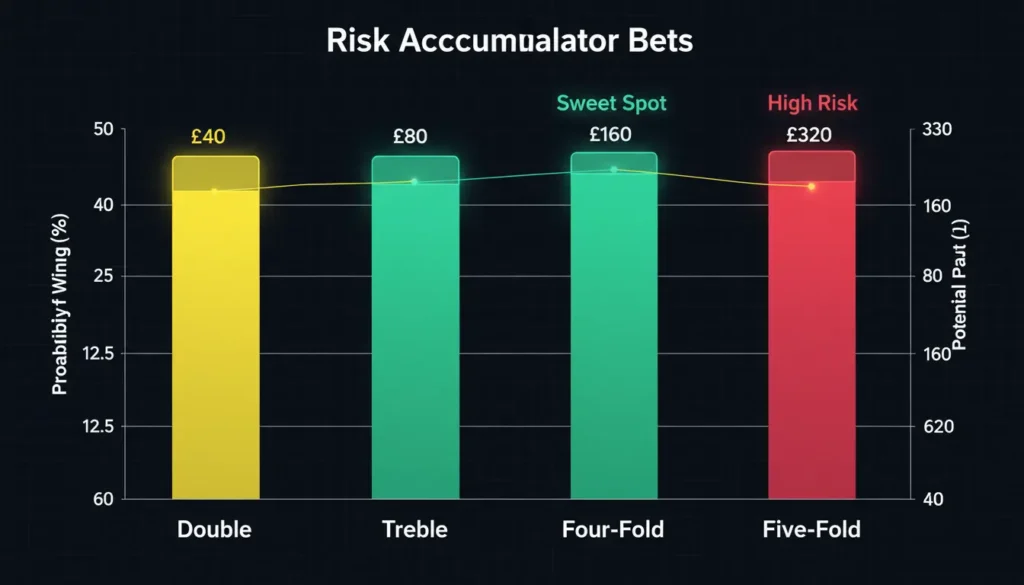
The optimal accumulator size depends on your goals and risk tolerance, but data and experience suggest three to five selections offers the best balance. Doubles don’t provide enough payout to justify the accumulator format over just betting the selections individually. Six-folds and larger drift into lottery ticket territory where your chance of winning becomes vanishingly small even if every individual selection is reasonably solid.
Three-folds and four-folds are the sweet spot. Three solid favorites at around 1.60 each pays about 4.00. Four at the same odds pays around 6.50. These aren’t life-changing returns but they’re attractive enough to make the accumulator worthwhile while keeping winning probability in the realm of plausible rather than miraculous.
Five-folds stretch into riskier territory but can work if you’re mixing selections across different match days. Spreading your accumulator across Saturday, Tuesday, and the following Saturday matches gives you information as selections settle, letting you hedge if you get deep into the accumulator. Single-day five-folds lack this flexibility and become much more about luck than strategy.
Mixing markets within accumulators is underutilized by most bettors who just pile on match result selections. Combining match results with over-unders and both teams to score reduces correlation between selections and sometimes offers better odds for similar probability. Instead of backing four favorites to win, try backing two favorites, one over 2.5 goals, and one BTTS. The payout might be similar but the selection diversity improves your probability slightly.

The key is understanding correlation. Backing Burnley to win and over 2.5 goals in the same match is correlated because Burnley winning makes goals more likely. Bookmakers adjust odds for correlated same-match selections in bet builders to account for this. But backing Burnley to win, Sheffield United to win, and Middlesbrough over 2.5 goals in three separate matches has minimal correlation. The outcomes are largely independent, which is what you want in accumulators.
Home favorites are accumulator staples because they win more frequently than other selections. Championship home favorites win roughly sixty-five to seventy percent of their matches depending on how you define favorite. Three home favorites at 1.50 each gives you a three-fold at about 3.40 with a winning probability around 32 percent if the odds are accurate. That’s far from certain but it’s not crazy either.
The danger with home favorites is they’re often overbet by the public, meaning the odds are shorter than the true probability justifies. Everyone sees the obvious home favorite and piles in, driving odds from what might have been fair value at 1.60 down to 1.50 where there’s no value. You’re taking short odds on selections that don’t actually win as often as those odds imply. Over many accumulators, this value deficit destroys your bankroll.
Form-based selection focuses on teams currently performing well regardless of opposition quality. A team that’s won four straight, even against weak opposition, has momentum and confidence that often carries through to the next match. The Championship has pronounced form cycles where teams get hot for stretches and cold for stretches. Riding the hot streaks makes intuitive sense.
But form is also mean-reverting. Teams on four-match winning runs are often due for regression, especially if underlying statistics suggest they’ve been fortunate. Check expected goals and shot quality rather than just results. A team winning while being outshot and getting lucky with finishing will regress. A team winning while dominating statistically will more likely sustain their form. Distinguishing genuine quality from temporary variance is crucial for form-based accumulator building.
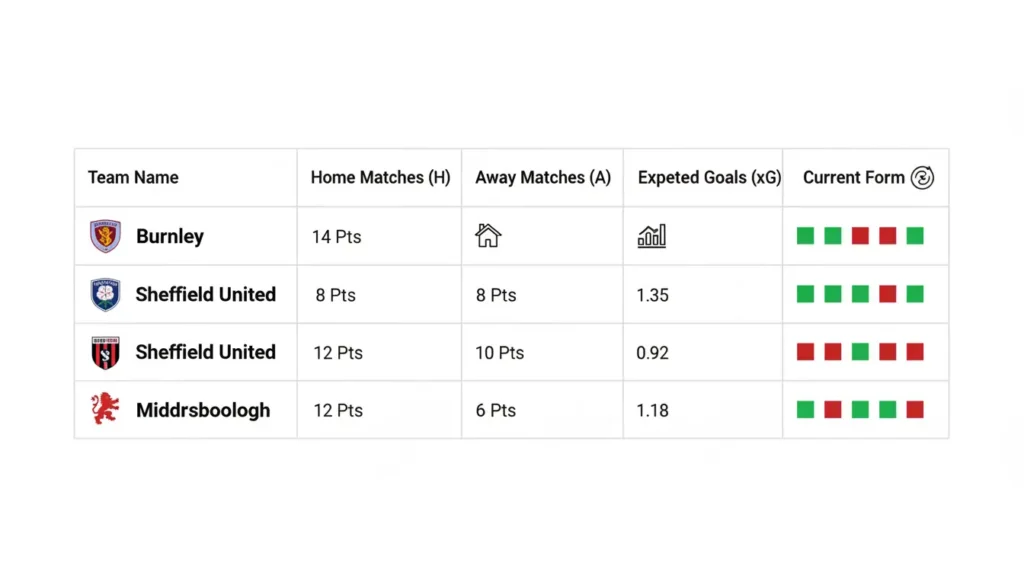
Banker selections are the legs you’re most confident in, the teams you’d back even at shorter odds because you believe they’re near-certainties. Every accumulator should have at least one banker. This is your foundation, the selection you build around. If your banker isn’t actually reliable, your entire accumulator is built on sand regardless of how good your other selections are.
Common banker candidates include dominant home teams against weak opposition, teams with something to play for against teams who don’t, and matches where the quality gap is obvious and the favorite is properly motivated. A playoff-chasing team hosting a mid-table opponent with nothing to play for in April is banker material. A mid-table team hosting another mid-table team in February probably isn’t.
Avoiding correlation between selections protects against systemic failures where one event causes multiple legs to fail simultaneously. Backing three teams from the same matchday is fine because the matches are independent. Backing three teams from the same region playing in similar conditions isn’t ideal because weather or other factors might affect all of them. Backing three teams that play similar styles against similar opposition types creates tactical correlation where if one loses, others might too.
Geographic and stylistic diversity in your accumulator selections reduces correlation risk. Mix teams from different areas playing different types of opponents. If one of your selections is a possession-heavy team against a low block, don’t make all your selections that same profile. Include variety in team styles and matchup types so a single tactical surprise doesn’t wreck your entire accumulator.
Championship Acca Selection Criteria
Team form analysis for accumulators requires looking deeper than win-loss records. Recent results matter but so do underlying performance metrics. A team might have lost their last two matches while dominating statistically and being unlucky. A team might have won their last two while being outplayed and getting fortunate. Surface results deceive. Dig into the performances.
Expected goals tell you about chance quality. A team consistently outperforming their expected goals will likely regress. A team underperforming their expected goals while still picking up points might actually be stronger than their position suggests. Use xG as a regression indicator to avoid backing teams riding unsustainable luck and to identify undervalued teams whose results don’t reflect their performances.
Home advantage in the Championship is substantial enough that it should weight heavily in your accumulator selections. Home teams win roughly 46 percent of Championship matches while away teams win about 27 percent. This gap is wider than in the Premier League. Building accumulators around home teams immediately improves your base probability compared to accumulators including away teams.
But not all home advantages are equal. Some teams are fortresses at home and disasters away. Others are more consistent regardless of venue. Check home-away form splits for each team. A team that wins seventy percent of home matches but thirty percent away is clearly much stronger at home. A team that wins fifty percent both home and away doesn’t have pronounced home advantage. Prioritize teams with strong home records for accumulator selections.
Motivation assessment is criminally underused in accumulator building. Teams fighting for promotion or against relegation play with urgency and intensity that mid-table teams coasting to the season’s end don’t match. Late-season accumulators should weight heavily toward teams with something tangible to play for. A team needing to win to stay in playoff contention will treat that match completely differently than a team in twelfth place for whom the season is basically over.
The difficulty is identifying genuine motivation differences versus assumed ones. Just because a team is fighting relegation doesn’t mean they’ll suddenly play well. Sometimes the pressure crushes them. Sometimes the squad quality is so poor that motivation can’t overcome it. Motivation matters most when combined with adequate quality. A decent team that’s highly motivated beats a better team that isn’t. A terrible team that’s motivated just loses urgently.
Fixture difficulty varies wildly across the Championship season. Playing six teams from the bottom eight in eight weeks is much easier than playing six teams from the top eight. When building accumulators, check upcoming fixtures not just for the current match but for the surrounding matches. A team with an easy run of fixtures might be resting players or rotating squad during one of those easier matches, unexpectedly dropping points.
Schedule congestion affects Championship teams severely. Teams playing three matches in eight days perform measurably worse than teams playing once per week. This is particularly pronounced for teams with thin squads that can’t rotate without significant quality drops. When selecting teams for accumulators, check their recent and upcoming fixture schedules. A team playing their third match in a week is higher risk than the same team well-rested.
Head-to-head records between teams sometimes reveal consistent patterns worth considering. Some teams just have numbers on others regardless of current form or table position. If Team A has beaten Team B seven times in the last nine meetings across multiple seasons, there’s probably something tactical or psychological at play. These historical patterns don’t guarantee future results but they’re data points worth considering when selecting accumulator legs.
Be careful with head-to-head records though. Squads and managers turn over in the Championship. The team that historically dominated this fixture might have completely different players and tactics now. Check whether the pattern persists with current personnel or whether it’s based on players and managers who’ve since moved on. Historical patterns only matter if the underlying reasons still exist.
Team news and suspensions can make or break accumulator selections. A team missing their best striker and starting center-back is significantly weaker than at full strength. If you’re selecting them for your accumulator based on their overall quality, you need to know about these absences before placing your bet. Team news typically emerges one to two hours before kickoff, which means waiting until team sheets are confirmed before finalizing your accumulator.
The trade-off is that odds worsen as kickoff approaches and information becomes public. If you wait for confirmed team news, you’re getting worse odds than if you’d bet the night before. But you’re also avoiding the disaster of backing a team whose key players are unexpectedly rested or injured. For accumulators where one leg failing costs you everything, waiting for team news is usually worth the slightly worse odds.
Advanced Accumulator Strategies
Acca insurance is a promotion many bookmakers offer where they refund your stake as a free bet if one selection in your accumulator loses. The terms vary by bookmaker. Some offer it on accumulators of five or more selections. Others on four-plus. The refund might be as a free bet up to a certain amount, often ten or twenty pounds. This insurance significantly improves your expected value by providing consolation when you get desperately close.
The catch is that acca insurance usually requires accumulators above a certain size and with minimum odds per selection. You might need five-folds or larger with each selection at minimum 1.40 odds. This pushes you toward larger accumulators than optimal strategy suggests. The insurance is valuable but not valuable enough to justify building seven-fold accumulators if you’d otherwise stick to four-folds. Use insurance when it’s available on sensible-sized accumulators but don’t let it drive you toward excessively large accumulators.
Partial cash-out strategy involves taking some profit from winning accumulator positions while leaving part of your stake running on the remaining selections. If you’ve got a four-fold accumulator and three legs have won, you can partially cash out for guaranteed profit while leaving some stake on the final leg. If that leg wins, you don’t get maximum profit but you’ve secured guaranteed returns. If it loses, you’ve at least recovered something rather than nothing.
The mathematics of partial cash-out depend on the offered value relative to fair market odds. Bookmakers build margins into cash-out offers, so you’re never getting true fair value. But sometimes the guaranteed profit is worth accepting slightly unfair odds rather than letting the entire position ride. If your four-fold is three-quarters through and you’re looking at either £200 profit or £0, taking £120 guaranteed might be sensible risk management even if it’s not mathematically optimal.
Accumulator boosts are promotions where bookmakers enhance your accumulator odds by a percentage, typically five to twenty-five percent depending on the number of selections. A standard four-fold at 10.00 might become 12.00 with a twenty percent boost. This directly improves your expected value assuming your selections are reasonable. Boosts don’t make bad accumulators good but they make good accumulators better.
Pay attention to boost terms and conditions. Some apply only to pre-match bets, others include in-play. Some require accumulators of a minimum size. Some exclude certain markets or maximum stake limits. Understanding the terms lets you maximize boost value by structuring accumulators to qualify for the best available boosts across different bookmakers.
System bets provide insurance against single-leg failures by covering multiple combinations within your selections. A Lucky 15 covers four selections in fifteen bets: four singles, six doubles, four trebles, and a four-fold. If all four win, you hit everything. If three win, you still profit from the trebles and doubles. If two win, you profit from the double. This insurance costs more since you’re placing fifteen bets rather than one, but it smooths variance significantly.
System bets make sense when you have genuine confidence in most of your selections but uncertainty about one or two. The insurance protects against the frustration of getting three out of four right and walking away with nothing. The downside is higher total stakes and less explosive returns since you’re not betting everything on the long-shot four-fold. System bets are for bettors prioritizing risk management over maximum payout.
Hedging your accumulator as selections win involves placing opposing bets on remaining legs to guarantee profit regardless of final outcomes. If you’ve got a four-fold and three legs have won, you can bet against the final leg. If the final leg wins, your accumulator pays out massively. If it loses, your hedge bet wins and you still profit, just less. This is essentially DIY partial cash-out without using the bookmaker’s cash-out feature.
The advantage of manual hedging over cash-out is you’re getting market odds rather than bookmaker cash-out odds which include extra margin. The disadvantage is it requires multiple accounts, quick calculations during the final match, and nerves to actually place the hedge when you’re so close to a big win. Most people can’t bring themselves to bet against their own accumulator even when it’s mathematically correct to do so.
Multiple small accumulators instead of one large accumulator reduces variance through diversification. Instead of one four-fold at £10, place four different three-folds at £2.50 each with some overlapping selections. If one hits, you’re profitable. If multiple hit, you’re very profitable. If all miss, you’ve lost the same £10 but you had four different chances rather than one. This approach sacrifices the lottery-ticket upside of the single large accumulator but improves your consistency.
The challenge is that multiple accumulators require more time to build and manage. Instead of making four selections and combining them, you’re making eight to ten selections and structuring them into multiple accumulators with strategic overlap. This is only worth it if you’re serious about accumulator betting and treating it as a skill to develop rather than casual fun. For recreational punters placing one acca per weekend, the extra complexity isn’t worth it.
Common Championship Acca Mistakes
Going too big is the cardinal sin of accumulator betting. Eight-folds, ten-folds, twelve-folds crossing into mathematical absurdity where your winning probability is under one percent. Yes, the potential payout is enormous. But you’re essentially buying lottery tickets at that point, not making bets based on analysis. The bigger your accumulator, the more likely it is to fail and the less likely that failure is due to bad luck versus inevitable probability.
The psychology behind massive accumulators is understandable. Small stakes, huge potential returns, and the intoxicating what-if scenario where everything lands. But discipline means recognizing that bigger isn’t better in accumulator betting. Keeping your accumulators to three to five selections maximizes the combination of reasonable winning probability and attractive returns. Everything beyond that is diminishing returns on strategy and increasing returns on hope.
Backing all favorites seems safe but it’s often a trap. Yes, favorites win more than underdogs by definition. But favorites in accumulators are generally overbet by the public, meaning their odds are shorter than their true winning probability justifies. You’re taking 1.50 odds on selections that should be 1.60. Do that four times in a four-fold and you’ve lost substantial expected value. Favorites-only accumulators work occasionally but they’re not sustainable long-term strategies.
The better approach mixes favorites with carefully selected value picks. Maybe two solid favorites, one value underdog, and one over-under selection. This diversifies your risk profile and often provides better expected value than straight favorites despite slightly higher perceived risk. The key word is careful selection. Random underdogs don’t improve your accumulator. Underdogs you’ve identified as underpriced relative to their quality do.
Ignoring fixture congestion costs accumulator bettors constantly. A team playing their third match in eight days is operating at reduced capacity. Players are tired, rotation forces weaker squads, and performances decline measurably. Yet bettors see the team name, remember they’re good, and chuck them in the accumulator without checking whether they’re dealing with fixture congestion. This leads to unexpected failures and wondering what went wrong.
Check every selection’s recent and upcoming fixture schedule before including them in your accumulator. A team on their third match in a week gets excluded or heavily discounted. A team coming off a two-week break with no midweek fixtures gets boosted. Fixture congestion is predictable and creates exploitable edges. Use it to your advantage rather than ignoring it and suffering the consequences.
Not tracking accumulator bets prevents learning and improvement. Most accumulator bettors place their weekly acca, it loses, they place another one next week without analyzing what went wrong. This is recreational gambling masquerading as betting strategy. If you’re serious about accumulator betting, you need to track every accumulator you place with details about selections, odds, outcomes, and reasoning.
After a few months of tracking, patterns emerge. You might realize you lose money on away selections but profit on home selections. You might discover your accumulators with BTTS legs outperform those with match result legs. You might see that four-folds hit at higher rates than five-folds justifying the shorter odds. This data is invaluable for refining your approach. Without tracking, you’re flying blind and repeating mistakes indefinitely.
Emotional selections destroy accumulator profitability. Throwing your team into the acca because you support them. Backing a friend’s team as a favor. Including teams you recently watched play well without analyzing whether they’re actually good value. Selections based on emotion rather than analysis are -EV by definition because your decision-making is compromised. Every selection in your accumulator needs rational justification independent of emotional attachment.
The discipline to exclude your own team from accumulators is difficult but necessary. Either you overvalue them because you’re a fan, or you undervalue them because you’re pessimistic after watching them disappoint you weekly. Either way, your assessment is compromised. Leave them out. There are twenty-three other teams to choose from. Your accumulator win rate will improve once personal attachment stops clouding judgment.
Chasing losses with bigger accumulators is the death spiral. Your four-fold loses on Saturday. You’re annoyed and want to win it back quickly. So Sunday you build a six-fold with longer odds selections because you need the big payout to recover. That loses too. Now you’re even deeper and the temptation to chase further intensifies. This pattern destroys bankrolls faster than anything else in betting.
The solution is treating each accumulator as an independent decision disconnected from previous results. Last week’s loser has zero bearing on this week’s selections. If your analysis says a four-fold is optimal, build a four-fold regardless of whether you’re up or down overall. Bankroll management and staking plans prevent chase-loss spirals by imposing discipline when emotions scream for escalation. Stick to your plan even when, especially when, you’re losing.
Managing Your Acca Bankroll

Staking plans for accumulators differ from single-bet staking because the higher variance requires more conservative stakes. A sensible approach is betting one to two percent of your bankroll per accumulator. If your bankroll is £500, your accumulator stakes should be £5 to £10. This ensures that even a long losing run won’t destroy your bankroll before variance turns in your favor.
The temptation is betting bigger on accumulators because the potential returns are so attractive. But bigger stakes don’t improve your expected value. They just increase variance. If your analysis is sound and your accumulators are well-constructed, the returns will come with proper staking. If your analysis is flawed, bigger stakes just lose money faster. Conservative staking protects you during downswings and lets your bankroll survive long enough to hit winners.
Unit systems for accumulators assign different stakes based on confidence. Your highest-confidence accumulators get two units. Standard confidence gets one unit. Speculative accumulators get half a unit. This variable staking lets you weight toward accumulators where your analysis is strongest while still taking shots on lower-confidence combinations that offer value despite higher risk.
The key is honest self-assessment about confidence levels. Most bettors think every accumulator they build is great, otherwise why would they build it? But realistically, some accumulators are built on firmer analysis than others. The unit system forces you to differentiate between your strongest plays and speculative punts, improving long-term returns by putting more money behind your best ideas.
Tracking every accumulator you place is non-negotiable for serious accumulator betting. Use a spreadsheet with columns for date, selections, odds, stake, outcome, and profit or loss. After each weekend, update your tracker. Over time, you’ll accumulate data about your accumulator success rate, average odds, and profitability by different variables like accumulator size, market types, and selection methods.
This tracking reveals which approaches work and which don’t. Maybe your four-folds hit at eighteen percent when they should hit at fifteen percent based on odds, indicating you’re finding genuine value. Maybe your five-folds hit at six percent when they should hit at ten percent, indicating you’re overreaching. This data drives improvement by showing you what to do more of and what to stop doing.
The ROI calculation for accumulator betting is return divided by total stakes over a meaningful sample size. If you’ve placed fifty accumulators staking £500 total and you’ve returned £550, your ROI is ten percent. This is your actual profitability metric independent of whether you’ve had recent winners or losers. Positive ROI over a hundred-plus accumulators indicates you’re doing something right. Negative ROI indicates adjustments are needed.
Most accumulator bettors never calculate their ROI because seeing the number would force them to confront that they’re losing money long-term. Ignorance feels better than knowledge when the knowledge is uncomfortable. But if you’re serious about betting rather than just using it as entertainment spending, you need to know your ROI and use it to guide decisions about whether to continue betting, adjust your approach, or stop altogether.
Build your winning tickets on our accumulator betting site.