
Stratégies pour les paris Outright
 Available in US
Betting on the Championship winner before the season starts or during it is one of those things that looks deceptively simple but turns out to be properly complicated once you dig in. You’re trying to predict which of twenty-four teams will finish first after forty-six matches spanning nine months, through injury crises, managerial sackings, transfer windows, and the kind of dramatic form swings that make the Championship what it is.
The appeal is obvious. Pre-season odds on eventual winners can be massive, turning modest stakes into serious returns. Leicester won the Championship at odds that would make you weep if you’d backed them early. But for every Leicester, there are a dozen Sunderlands who started the season as favorites and finished nowhere near the top. The trick is knowing which patterns to follow and which red herrings to ignore.
Outright betting is fundamentally different from match betting. You’re not predicting ninety minutes of football. You’re predicting months of accumulated performances, squad management, tactical evolution, and psychological resilience. The skills that make you good at match betting don’t automatically transfer. You need a different analytical framework, longer time horizons, and the stomach to watch your bet slowly play out over most of a calendar year.
This guide breaks down everything you need to know about Championship winner betting and the related outright markets. We’ll cover the patterns that repeat season after season, the mistakes that cost punters money, and the strategies that actually work when you’re trying to predict something as chaotic as a Championship season.
Focus on the race for the top with Championship winner betting tips.
Table of Contents
Understanding Championship Outright Betting
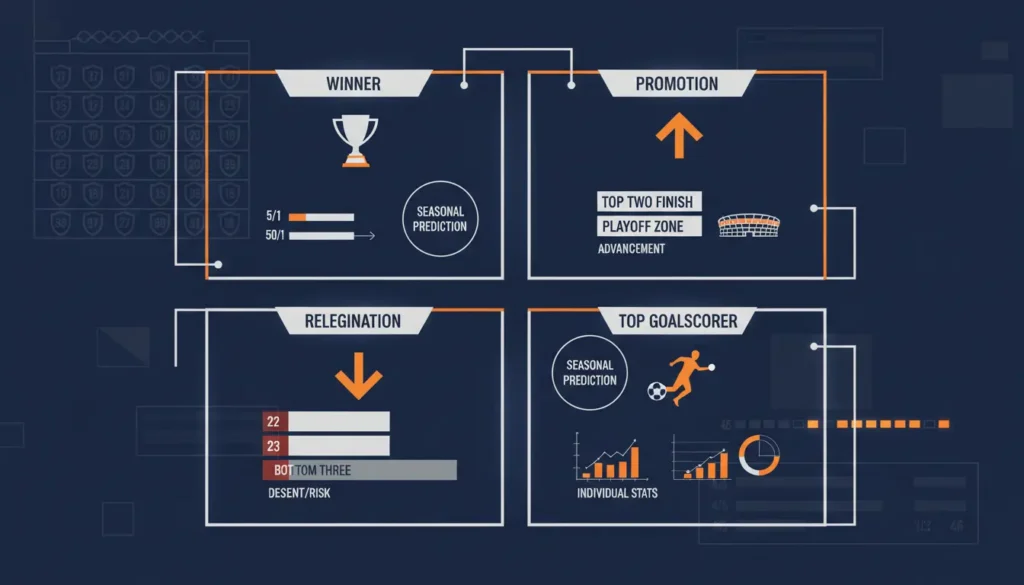
Outright bets settle once the season ends and final league positions are confirmed. You’re backing a team to finish in a specific position or range of positions, and nothing that happens during the season matters except where they end up in May. This creates a completely different dynamic from match betting where results are known within two hours.
The Championship winner market is straightforward enough. You back a team to finish first after forty-six matches. The odds reflect the bookmaker’s assessment of each team’s chances, adjusted for their margin. Pre-season favorites might be 5-1 or 6-1, mid-tier teams 15-1 to 25-1, outsiders 50-1 or longer. These odds shift throughout the season as form develops and circumstances change.
Promotion markets offer more ways to win. Instead of needing your team to finish first, you need them to finish in the top two for automatic promotion or top six for playoff qualification. The odds are shorter because the target is easier, but you still profit if your team achieves the goal. Some bookmakers offer each-way terms on promotion bets, paying reduced odds if your team makes the playoffs even if they don’t ultimately get promoted.
Relegation betting works the same way in reverse. You’re backing teams to finish in the bottom three and drop to League One. The odds reflect perceived relegation risk, with newly promoted teams and struggling sides shortest and established Championship clubs longest. Relegation markets move dramatically as the season progresses and teams enter or escape danger zones.
Top goalscorer markets let you back individual players to finish as the Championship’s leading scorer. This requires analyzing not just player quality but team style, penalty responsibilities, and injury history. Strikers at dominant teams get more chances. Penalty takers have enormous advantages since five or six spot kicks can swing the entire market.
The crucial thing about outrights is that they tie up your stake for months. You can’t get your money back until the bet settles, though many bookmakers now offer cash-out options that let you close positions early for a profit or to cut losses. This liquidity issue means you need to be comfortable with the stake being unavailable for extended periods, which affects how much you should risk on outright markets versus match betting.
Championship Winner Betting: The Main Event

Predicting the Championship winner requires understanding what actually wins Championships. The tempting answer is quality, but quality alone doesn’t cut it. Plenty of talented teams have underperformed while less heralded sides surged to the title. What wins Championships is the combination of quality, squad depth, managerial competence, momentum, and luck.
Historical patterns are remarkably consistent. The Championship winner almost always comes from the group of teams that finished in the top ten the previous season or were relegated from the Premier League. Genuinely surprising winners are rare. The league is too long and too demanding for fairy tales. Teams need underlying quality and resources to sustain forty-six matches at winning pace.
Relegated Premier League teams arrive with structural advantages. They keep parachute payments that dwarf Championship budgets, letting them maintain wage bills other clubs can’t match. Their squads contain players who competed at the highest level months earlier. The facilities, coaching, and infrastructure exceed Championship standards. These advantages don’t guarantee success but they stack the deck significantly.
The catch is psychological. Players who spent last season getting hammered in the Premier League arrive demoralized. Some struggle with the Championship’s physical demands and compressed schedule. The expectation of immediate promotion creates pressure that not every team handles well. When relegated teams fail to bounce back immediately, it’s usually because they couldn’t make the mental adjustment rather than lacking quality.
Squad depth separates contenders from pretenders by Christmas. The Championship’s fixture congestion is brutal. Teams play midweeks regularly, sometimes three matches in seven days. Clubs with strong starting elevens but weak depth get found out when injuries accumulate and fatigue sets in. Winners typically have eighteen to twenty players capable of Championship-standard performances, not just eleven.
Look at squad composition carefully before placing winner bets. How many players have Championship experience? How deep is each position? What’s the age profile? Teams relying heavily on loan players face risks if those loans aren’t renewed or if parent clubs recall players mid-season. Teams with stable, owned squads have more certainty and control.
Managerial experience matters more in the Championship than in other leagues. The season’s length and intensity demand tactical flexibility and squad rotation skills. Managers who’ve succeeded in the Championship before understand its rhythms and demands. Those arriving from other leagues often struggle initially, even if they’re talented coaches. Daniel Farke and Nathan Jones built reputations by mastering Championship football specifically.
Pre-season favorites offer poor value more often than not. Bookmakers and the public overreact to big names and recent Premier League status, creating odds that don’t reflect actual winning probability. A team might be genuinely the best in the division but if they’re 4-1 to win when their true probability is 20 percent, that’s a terrible bet even though they might win.
Better value often hides with teams the market underestimates. A club that finished sixth last season, kept their manager and key players, made smart additions, but isn’t a fashionable name might be 18-1 when their true chances are closer to 10-1. These overlooked contenders are where value lives because the odds haven’t fully adjusted to their quality.
Timing your winner bets requires thinking about when value exists. Pre-season odds incorporate uncertainty about signings, sales, and form. If you’ve identified a team positioned to succeed, backing them before the season offers maximum odds. But pre-season also carries maximum risk since you don’t know how the pieces will fit or whether key players will stay healthy.
In-season winner bets can offer value when the market overreacts to short-term results. A contender that starts slowly might see their odds balloon to 15-1 despite still being a quality team likely to improve. If your analysis suggests the slow start was variance rather than genuine weakness, those inflated odds represent opportunity. Conversely, teams that start hot sometimes see their odds shorten beyond what their underlying quality justifies.
The sweet spot is usually after ten matches. You’ve seen enough to identify genuine contenders versus pretenders, but the season is young enough that good teams who started slowly haven’t yet corrected their odds fully. This middle period offers the best combination of information and value for winner bets.
Promotion Betting Strategies
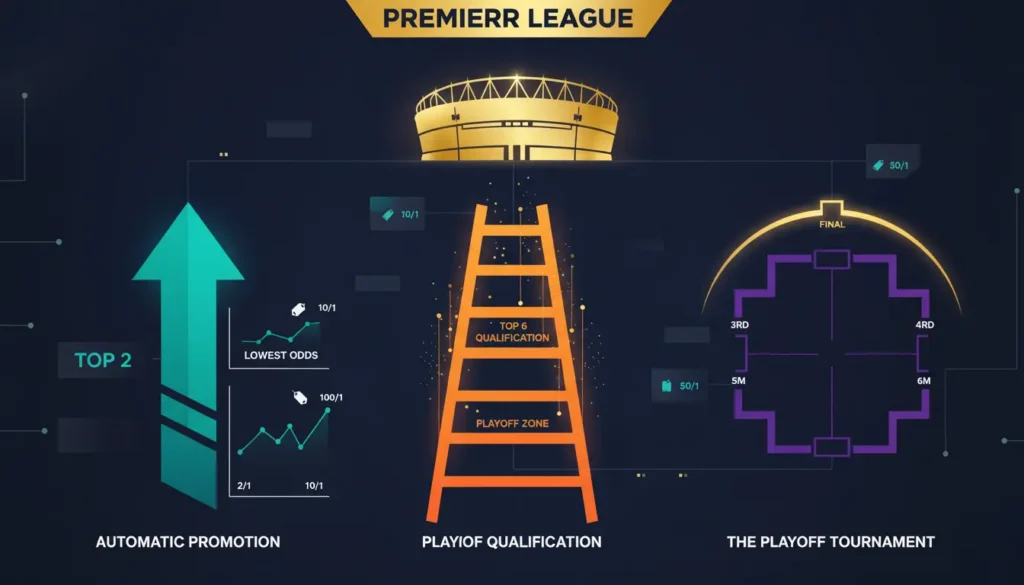
Promotion bets are more forgiving than winner bets because three teams achieve promotion. You can spread risk across multiple selections and still profit if two or three come through. The lower odds reflect the higher probability, but the improved success rate makes promotion betting attractive for punters who want exposure to outright markets without the winner-take-all dynamic.
Automatic promotion, finishing in the top two, is the cleanest route to the Premier League. Teams in these positions avoid the playoff lottery and know their fate on the final day. The odds on automatic promotion are tighter than winner odds but shorter than playoff qualification odds, typically ranging from 2-1 for favorites to 10-1 for outsiders.
The key insight with automatic promotion bets is that it’s effectively a top-two market in a twenty-four team league. Form and consistency matter more than peak performance. Teams that grind out results week after week accumulate points steadily, while teams with higher ceilings but lower floors experience volatility that costs them over forty-six matches. For automatic promotion, reliability trumps brilliance.
Look for teams with defensive solidity and goal-scoring reliability. The Championship winners over the past decade have consistently ranked in the top three for both goals scored and fewest conceded. This isn’t coincidental. Forty-six matches reward balance. Teams that outscore their defensive weaknesses or defend their way through offensive droughts rarely sustain top-two finishes.
Home form is particularly crucial for automatic promotion. The teams that go up automatically almost always have fortress home records, winning at least seventy percent of home matches. Away form separates good from great. Contenders need to win half their away matches and avoid getting hammered in the games they lose. Teams that collapse away from home don’t accumulate enough points for automatic promotion.
Playoff qualification, finishing in the top six, offers more breathing room and shorter odds. Favorites might be 1.50 or 1.60 to make the playoffs, mid-tier teams 3-1 to 5-1. The value calculation changes because you’re asking which teams will finish in the top quarter of the league rather than the top two. This is easier to predict but offers less return.
Each-way betting on promotion splits your stake between the team winning outright and finishing in the place positions bookmakers specify. If the terms are top six at one-fifth odds, you get one-fifth of the winning odds if your team finishes in the top six without winning. This reduces variance and provides consolation if your team makes the playoffs but doesn’t win them. For punters who want outright exposure with less risk, each-way promotion bets offer sensible middle ground.
The playoff route to promotion is fascinating from a betting perspective because it’s simultaneously high-variance and somewhat predictable. The playoffs involve teams finishing third through sixth in two-legged semifinals and a Wembley final. The team that wins the final gets promoted. From a betting standpoint, you can back teams to win the playoffs before the season or during it, or bet on specific playoff matches as they happen.
Historical data shows teams finishing third or fourth win the playoffs slightly more often than teams finishing fifth or sixth, but the difference is much smaller than you’d expect. League position matters less in playoffs than form and momentum. Teams that limp into the playoffs after barely securing sixth place sometimes catch fire and win it all. Teams that cruise into third place sometimes can’t adjust to the knockout intensity.
Playoff betting requires understanding which teams handle pressure and knockout football. Experienced managers who’ve navigated playoffs before have edges. Teams whose best players show up in big matches have advantages. Clubs with recent cup runs demonstrating knockout competence should be taken seriously even if their league position suggests otherwise.
The timing of when you bet on promotion matters based on your risk tolerance. Pre-season promotion bets offer the longest odds but maximum uncertainty. Mid-season promotion bets after Christmas offer better information but shorter odds. The key is matching your bet timing to your information edge. If you’ve identified something the market hasn’t priced in, bet early. If you’re waiting for confirmation of form and fitness, bet later with shorter but safer odds.
Championship Playoff Betting

The Championship playoffs are their own beast, completely distinct from the regular season yet inexorably linked to it. They’re a four-team knockout tournament where the prize is Premier League promotion and the financial windfall that comes with it. The psychological stakes are enormous, which creates betting opportunities if you understand how pressure affects performance.
The playoff format is straightforward but crucial to understand for betting purposes. Teams finishing third through sixth enter. Third plays sixth, fourth plays fifth in two-legged semifinals played home and away. Aggregate score wins. If aggregate is level after both legs, extra time and penalties decide. The two winners advance to a single final at Wembley, neutral ground, winner promoted.
This format creates interesting dynamics. The league season rewards consistency over forty-six matches. The playoffs reward peak performance over three matches. These aren’t the same skill sets. Teams that ground out results all season sometimes lack the attacking quality to break down defensive playoff opponents. Teams that were inconsistent in the league sometimes have higher ceilings and match-winning individuals who decide tight playoff matches.
Home advantage in the first leg versus second leg is debated endlessly. Some argue hosting the second leg is preferable because you know exactly what result you need and play in front of your fans in the decisive match. Others argue hosting the first leg is better because you can build a lead to defend in the away leg. The data is mixed, with no clear statistical advantage either way. What matters more is which team handles pressure better, not which leg they host.
Momentum going into playoffs is criminally underrated by bookmakers. A team that secures playoff qualification weeks early and coasts through their final matches arrives cold. A team that scrapes into sixth place on the final day after a desperate run of wins arrives hot. The latter often outperforms their league position because they’re already in must-win mode. Bookmakers price playoff odds primarily on league position, creating value on momentum teams.
The Wembley final is one of football’s great occasions and one of sports betting’s most fascinating markets. It’s a single match, neutral ground, for a prize worth roughly two hundred million pounds. The pressure is absurd. Some players rise to it. Others crumble. Teams with Wembley experience, even from other competitions, have measurable advantages. Players who’ve performed on big stages before handle the occasion better than those making debuts.
Betting on individual playoff matches as they happen is different from betting on playoff winners before the playoffs start. Match betting uses the same principles as regular season match betting but with heightened awareness of the pressure and stakes. Players and teams who bottle it exist. They’re identifiable through past behavior in high-pressure situations. Fading teams with histories of choking in crucial matches offers value because casual bettors overlook psychological fragility.
The playoff final specifically rewards teams with experienced managers and big-game players. Nathan Jones’s Luton won the final despite not being favorites because they had a manager who’d been through it and players who’d performed in pressure situations before. Middlesbrough lost multiple finals with better squads because they lacked the mental edge. This isn’t mysticism. It’s psychology.
Betting on playoff winners early in the season means predicting which teams will both make the playoffs and then win them, which is asking a lot. Better value often comes from waiting until the playoff picture clarifies, then assessing which of the qualified teams has the attributes that win playoffs. This might be after the final day of the regular season when you know the matchups and can assess momentum, fitness, and psychological readiness.
The other approach is backing teams you think will make the playoffs at long odds, then hedging once they qualify by backing opponents in their playoff matches. This guarantees profit if they reach the final and offers substantial returns if they win it. The hedge strategy works particularly well with teams whose pre-season playoff odds were long but who’ve demonstrated quality warranting playoff qualification.
Relegation Betting Markets
Relegation betting is the dark mirror of promotion betting. You’re backing teams to fail spectacularly, finish in the bottom three, and drop into League One. The psychology of relegation betting feels different because you’re rooting for teams to struggle, but the strategic principles are identical. Find mispriced odds, assess probability accurately, and bet when value exists.
Newly promoted League One teams are the obvious relegation candidates and usually the shortest odds. The step up from League One to Championship is significant in quality, pace, and physicality. Teams that dominated the third tier often find themselves outmatched in the second tier. But the market knows this, so newly promoted teams are often overpriced as relegation favorites when their odds should be longer.
The value in relegation markets often lies with teams the public assumes are safe. An established Championship club that loses key players, faces financial problems, or appoints a questionable manager might be 12-1 for relegation when their true probability is more like 8-1. The market underrates relegation risk for teams with recent mid-table finishes because recency bias creates false comfort.
Squad quality matters enormously for relegation betting. Teams relying heavily on aging players, loan signings, or free transfers face structural disadvantages. The Championship’s physical demands expose weak squads ruthlessly. Injuries that would be manageable with depth become catastrophic without it. When assessing relegation candidates, look at squad depth even more than starting eleven quality.
Financial instability is a massive red flag. Teams entering administration, facing points deductions, or unable to pay wages are statistically far more likely to be relegated than financially stable clubs. The Championship’s financial landscape is precarious enough that several teams operate close to the edge every season. Monitoring financial news and club statements can give you edges the odds don’t fully reflect.
Managerial appointments signal relegation risk. When a struggling team appoints an inexperienced manager or recycles a manager with a history of failure, that’s a warning sign the odds often don’t fully price. Conversely, when a team appoints a manager with a strong track record of avoiding relegation, their odds should shorten but sometimes don’t immediately.
The timing of relegation bets matters differently than promotion bets. Pre-season relegation odds incorporate lots of uncertainty. Teams strengthen or weaken through the transfer window. Managers prove themselves capable or incompetent. Injuries hit or don’t. Betting relegation pre-season means accepting significant variance because you lack information about how teams will actually perform.
Mid-season relegation betting, particularly after Christmas, offers better information but shorter odds. By January, you can identify teams genuinely in trouble versus teams who started poorly but have stabilized. The odds reflect the league table more accurately mid-season, but occasionally the market overreacts to recent form creating value on teams whose underlying quality suggests they’ll escape despite being in the bottom three.
Late-season relegation battles create extraordinary betting opportunities because motivation gaps become extreme. A team in nineteenth place hosting a mid-table team with nothing to play for represents a massive psychological advantage the odds often underestimate. The home team is fighting for survival. The visitors are mentally on vacation. These motivational edges win matches and create value.
The bottom-three finish market differs slightly from the relegated market because of playoff implications. Finishing twenty-second versus twenty-fourth might matter less than you’d think since all three go down. What matters for betting is whether teams accumulate enough points to finish in the safe zone, typically requiring around fifty points though the exact line varies yearly.
Top Goalscorer Betting
The Championship top goalscorer market offers a completely different type of outright bet focused on individual performance rather than team results. You’re backing a player to outscore every other player in the division over forty-six matches. This requires analyzing individual quality, team supply, penalty duties, and injury risk.
Strikers at dominant teams are the obvious candidates and usually the favorites. If a team is expected to score eighty goals and one striker takes most of them, that player is likely to finish near the top of the scoring charts. But favorites are often overpriced because casual bettors pile on big names at big clubs, shortening odds beyond what the probability justifies.
Each-way terms on top goalscorer bets typically pay down to three or four places at one-fifth or one-quarter odds. This significantly improves your probability of returning something. If you back a striker at 12-1 with four-place each-way terms at one-fifth odds, you profit if he finishes in the top four even if he doesn’t win outright. This reduces variance and makes longer-priced selections viable.
Penalty takers have massive advantages that odds don’t always fully reflect. A striker who takes penalties for a team that earns ten penalties over the season gets ten extra scoring opportunities. In a market where the winner typically finishes with twenty-five to thirty goals, ten penalties is the difference between winning and finishing mid-table. Identify penalty takers at teams likely to earn penalties frequently through possession and attacking play.
Team style matters as much as individual quality. A world-class striker at a defensive team that creates few chances will struggle to top the scoring charts. A decent striker at an attacking team that creates chances constantly can rack up goals through volume. Assess expected team performance and offensive output when evaluating top scorer candidates.
Injury history is crucial because missing even five or six matches costs scoring opportunities. A striker who’s injury-prone might be technically gifted but unreliable for top scorer bets because he won’t play enough matches. Durability and fitness are underrated attributes in top scorer markets. The winner almost always plays at least forty matches.
The timing of top scorer bets creates different strategic considerations. Pre-season odds offer maximum value on overlooked players but maximum risk because you don’t know if they’ll stay healthy, keep starting, or maintain form. Mid-season odds offer better information but shorter prices. Players in good scoring form see their odds shorten dramatically after five or six goals in quick succession.
Multiple selections make sense in top scorer markets given the variance involved. Instead of putting everything on one striker at 10-1, consider spreading across three strikers at 15-1, 18-1, and 20-1. If any hits, you profit substantially. If multiple hit the each-way places, you profit from multiple selections. This diversification reduces the impact of bad luck derailing a single selection.
Watch for striker transfers and loan moves. A proven scorer moving from a struggling team to a promotion contender sometimes sees their odds lengthen because bookmakers haven’t fully adjusted their models. Similarly, a striker joining a team on loan from the Premier League might arrive with deflated odds because bookmakers rate their quality but underestimate how much easier Championship football will be for them.
Advanced Outright Betting Strategies

Hedging outright bets transforms them from pure gambling into strategic position-taking. If you back a team to win the Championship at 20-1 before the season and they’re leading the table in March, you can hedge by backing their closest competitors to reduce risk while guaranteeing profit. The art is knowing when to hedge and how much.
Early hedging locks in profits but reduces maximum returns. If your pre-season 20-1 shot is now 3-1 favorite, you could back the second-place team at 5-1 and guarantee profit regardless of who wins. You won’t make as much as if your original bet wins outright, but you’ve eliminated risk. This is sensible if you believe the race is genuinely tight and your team might not hold on.
Late hedging waits until the final weeks when outcomes are nearly certain. If your team clinches the title with two matches remaining, there’s no need to hedge. You’ve won. But if they need to win their final match to finish first, hedging on a draw or opponent win guarantees you profit regardless of that final result. This is essentially buying insurance against your team bottling it on the final day.
Cash-out options from bookmakers provide automated hedging. Many bookmakers now offer cash-out on outright bets, letting you close your position early for a guaranteed amount. The cash-out value reflects the current market odds minus the bookmaker’s margin, so you’re never getting full fair value. But cash-out provides liquidity and removes decision-making stress about when and how to hedge manually.
Trading positions means treating outright bets like financial instruments that you buy and sell for profit. If you back a team at 15-1 pre-season and they start brilliantly, their odds might drop to 6-1. You could then lay them at 6-1 on an exchange, locking in profit regardless of whether they ultimately win. This requires access to betting exchanges and comfort with lay betting, but it transforms outrights from static bets into dynamic trading positions.
Multiple outright strategies involve backing several teams simultaneously with the expectation that at least one performs well enough to justify the combined stakes. This sounds counterintuitive but works mathematically if you’re finding genuine value. If you back three teams at 18-1, 20-1, and 25-1 spending thirty units total, you only need one to finish in the top two for each-way terms to profit.
The key is backing genuinely underpriced teams, not just spreading randomly. If you think three teams each have a ten percent chance of winning but their odds imply five percent, backing all three makes sense because you’re getting double your fair value on each. But if you’re backing random teams hoping one gets lucky, you’re just burning money.
Combining outrights with match betting creates interesting strategies. If you’ve backed a team for promotion and they’re in a crucial match, you can bet against them in that specific match to protect your outright position if you think they’ll lose. This sounds counterintuitive but it’s just hedging at the match level rather than the outright level.
Season-long accumulator strategies involve placing small outright bets on multiple teams throughout the season, adding positions as value emerges. Maybe you back two teams pre-season, add another in October when they show promise, add two more in January after the transfer window. This drip-feeding of bets spreads risk across time and lets you incorporate new information without being locked into pre-season assessments.
The psychology of outright betting differs from match betting because results play out over months rather than hours. You need patience to watch your bet slowly develop, discipline to avoid panicking during bad runs, and ruthlessness to hedge when appropriate even if it feels like you’re betting against yourself. The emotional discipline required for outright betting is substantial and often underestimated by bettors used to the quick resolution of match bets.
Outright betting rewards research more than luck because sample size is large. Over forty-six matches, quality and structure matter more than variance. The best team doesn’t always win, but they finish in the top six almost always. Your job is identifying which teams have the underlying quality to sustain success over a full season rather than which teams will get hot for a few matches. This requires different analytical skills than match betting but ones that are learnable and improvable with practice.
Predict the full season on our Championship betting hub.