
Value Betting : Trouver l'avantage
 Available in US

Value betting represents the only sustainable approach to profitable wagering. Rather than backing selections you think will win, value betting means backing selections whose odds exceed their true probability of success. A team with 40% win probability at odds of 3.00 offers value regardless of whether they actually win, because 3.00 implies only 33% probability. Over sufficient volume, backing genuine value produces profit even though individual bets frequently lose.
The Championship offers unique value opportunities that premier leagues cannot match. Less media coverage means less information reaches casual bettors, creating knowledge gaps that informed analysts can exploit. The division’s competitive parity means bookmakers face difficult pricing challenges where small probability misjudgments create exploitable odds. The volume of matches, 552 per season, provides sufficient opportunities to realize theoretical edges through practical betting.
What makes value betting challenging is distinguishing genuine edge from random variance. A successful bet doesn’t prove you found value, and a losing bet doesn’t prove you were wrong. Only sustained profit over meaningful sample sizes demonstrates genuine edge. This requirement for patience and discipline separates successful value bettors from the majority who eventually deplete their bankrolls.
Combine value with discipline by following our bankroll management guide.
Table of Contents
Understanding Expected Value
Expected value calculations provide the mathematical foundation for value betting decisions. Understanding these calculations helps identify when betting opportunities genuinely offer positive expectation.
Expected value equals the probability of winning multiplied by potential profit, minus the probability of losing multiplied by stake. For a £100 bet at odds of 2.50 on a selection with 45% true probability, expected value calculates as (0.45 × £150) – (0.55 × £100) = £67.50 – £55 = £12.50. Positive expected value indicates a valuable bet regardless of whether this particular bet wins or loses.
Implied probability converts bookmaker odds into the probability they’re pricing. Odds of 2.00 imply 50% probability. Odds of 3.00 imply 33.3%. Odds of 1.50 imply 66.7%. Comparing your assessed probability against implied probability reveals whether value exists. When your probability exceeds implied probability, value exists.
Edge percentage quantifies value magnitude. If you assess 45% probability for odds implying 40%, your edge is 5 percentage points, or 12.5% of the implied probability. Larger edges justify larger stakes because they’re more likely to represent genuine advantage rather than estimation error.
Identifying Value in Championship Markets
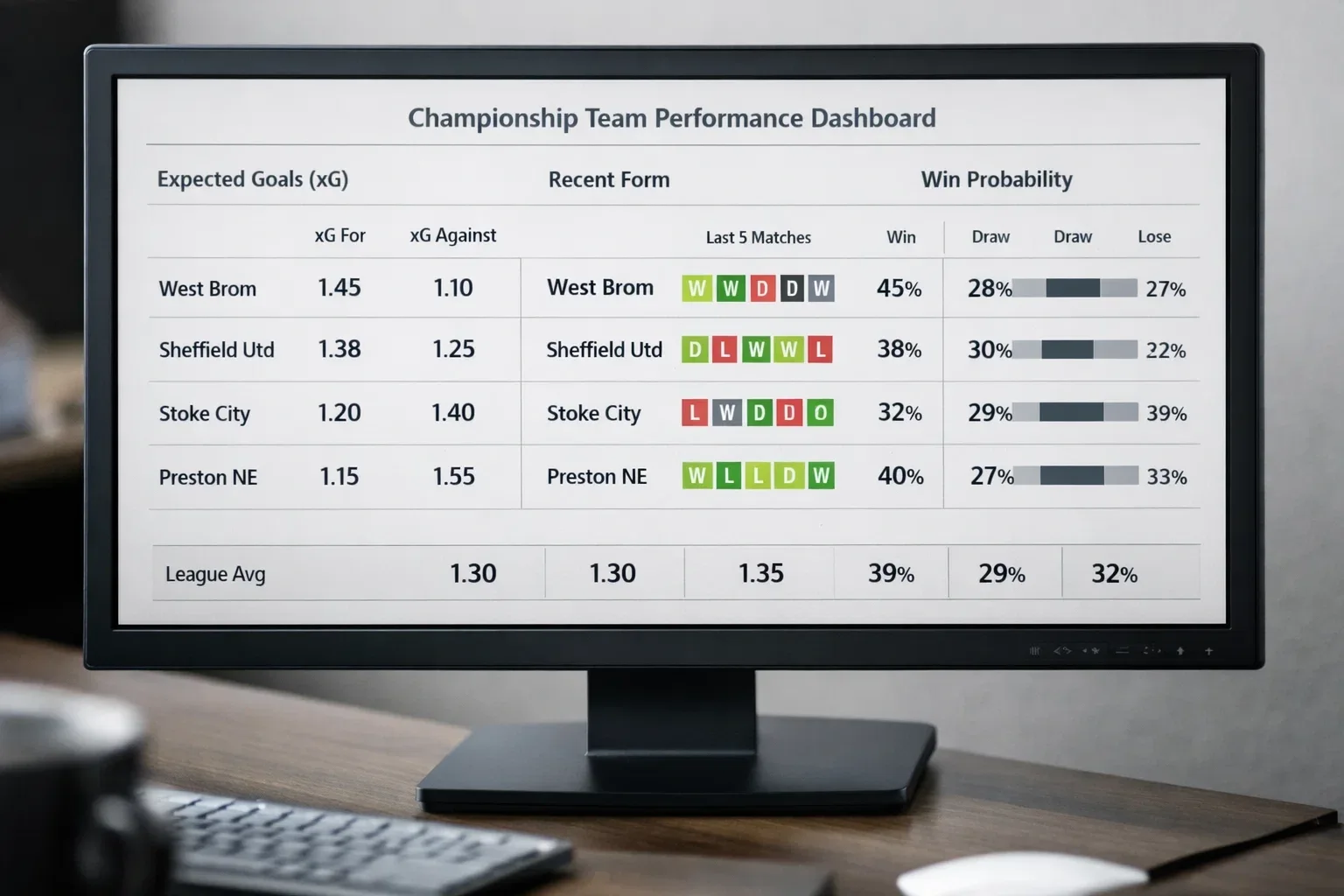
Championship markets contain value opportunities that systematic analysis can identify. Several approaches help locate situations where odds don’t reflect true probabilities.
Team analysis reveals mispriced sides whose form, quality, or circumstances markets haven’t properly assessed. Newly appointed managers whose capabilities exceed their predecessors, returning injured players whose impact markets underestimate, or tactical adjustments opponents haven’t yet countered can all create value opportunities that statistical models alone might miss.
Situational factors affect probability in ways markets sometimes overlook. Teams with nothing to play for facing those in promotion or relegation fights might underperform their quality. Fixture congestion affects some sides more than others based on squad depth. These situational dynamics create value when markets price teams on raw form rather than contextual factors.
Market overreactions to recent results produce temporary mispricings that alert bettors can exploit. A team losing heavily in one match might see their odds drift beyond reasonable levels for subsequent fixtures. Recognizing when markets have overreacted to variance rather than genuine quality signals helps identify value.
Building Your Probability Assessments
Value betting requires developing your own probability assessments to compare against market prices. Several approaches help build reliable probability estimates.
Historical base rates provide starting points for probability estimation. Championship home teams win approximately 45% of matches. Teams with specific recent form patterns historically produce certain outcome distributions. These base rates anchor probability assessments that other factors then adjust.
Performance metrics beyond results reveal underlying quality that results might obscure. Expected goals data shows whether teams are over or underperforming their chance creation and concession. Teams whose results exceed their metrics face regression, while those underperforming underlying numbers might improve. These metrics help assess probability more accurately than raw results.
Situational adjustments modify base rates for match-specific circumstances. Derbies historically produce elevated draw rates. Matches involving teams with nothing to play for show different patterns than high-stakes fixtures. Incorporating situational factors refines probability estimates.
Bankroll Management for Value Betting
Sustainable value betting requires disciplined bankroll management that accounts for the variance inherent in betting positive expected value selections. Without proper bankroll management, even genuine value bettors can deplete their funds through normal losing streaks.
Kelly criterion provides mathematically optimal stake sizing based on edge magnitude and bankroll size. The formula suggests staking a percentage of bankroll equal to edge divided by odds minus one. A 10% edge at odds of 3.00 suggests staking 5% of bankroll. While full Kelly proves aggressive for most bettors, fractional Kelly approaches, typically quarter or half Kelly, balance growth with drawdown protection.
Fixed percentage staking offers simpler alternative approaches. Staking consistent percentages of current bankroll, typically 1-3% per bet, automatically reduces stakes during losing periods and increases them during winning runs. This approach requires less precision in edge estimation than Kelly methods.
Loss limits prevent catastrophic drawdowns during extended negative variance. Setting daily or weekly limits that halt betting after specified losses protects bankrolls from damage during periods when edge might not be materializing. These limits should trigger review of approach rather than stake escalation.
Tracking and Analysis
Systematic tracking enables assessment of whether your approach genuinely produces edge or merely reflects fortunate variance. Without proper tracking, distinguishing skill from luck becomes impossible.
Record every bet including date, match, market, odds, stake, and outcome. Calculate running totals for stakes, returns, and profit. This baseline data enables all subsequent analysis that reveals whether your betting produces genuine edge.
Analyze results by various dimensions: market type, team, situation, odds range, and any other categories relevant to your approach. Identifying where you perform best and worst helps focus future betting on strongest areas while addressing or abandoning weaknesses.
Statistical significance assessment reveals whether results could arise from luck alone. Positive results over a handful of bets prove nothing; bookmakers profit despite individual customers winning through variance. Only sustained positive results over hundreds of bets begin demonstrating genuine edge that luck alone cannot explain.
Common Value Betting Pitfalls
Recognizing and avoiding common errors improves value betting results. These pitfalls recur because value betting requires different mindsets than recreational wagering.
Confusing value with likelihood leads to backing short-priced selections simply because they’re likely to win. A 75% probability selection at 1.25 odds offers no value because fair odds would be 1.33. Value depends on the relationship between probability and odds, not probability alone.
Chasing perceived value without genuine analysis produces positions based on feeling rather than rigorous probability assessment. Simply believing odds are too long doesn’t create value. Only systematic analysis that produces reliable probability estimates can identify genuine value.
Abandoning approach during drawdowns destroys value betting before edges materialize. Variance guarantees losing periods even for genuinely profitable approaches. Maintaining discipline through inevitable drawdowns separates successful value bettors from those who quit before their edge produces returns.
Overconfidence in probability assessments leads to oversized positions that bankrolls cannot sustain. Your probability estimates contain uncertainty that stakes should reflect. Smaller positions acknowledge assessment uncertainty while still capturing identified value.
Conclusion: Building a Long-Term Value Betting Strategy

Value betting requires patience and perspective that differs from recreational betting’s immediate gratification. Understanding what sustainable profitability actually looks like helps maintain appropriate expectations.
Profit emerges slowly over significant sample sizes. Even substantial edges produce modest monthly returns when properly managed. Expecting rapid wealth from value betting leads to frustration and approach abandonment. Realistic expectations of gradual bankroll growth sustain motivation through inevitable difficult periods.
Skill development continues indefinitely. Markets evolve, odds compilers improve, and successful approaches face diminishing returns as others adopt similar methods. Continuous learning and adaptation maintain edge as markets adjust to previously successful approaches.
Process focus trumps outcome focus. Whether individual bets win matters less than whether your process reliably identifies positive expected value. Trust your process through variance rather than abandoning sound approaches after losing runs or becoming overconfident after winning streaks.
Championship value betting rewards those who approach wagering as analytical discipline rather than entertainment. The mathematical principles guarantee profit over sufficient volume for those who genuinely identify value, but realizing that profit requires patience, discipline, and continuous improvement that most bettors never develop.
Beat the bookies using our second-tier sportsbook guide.